Not the Obvious Choice
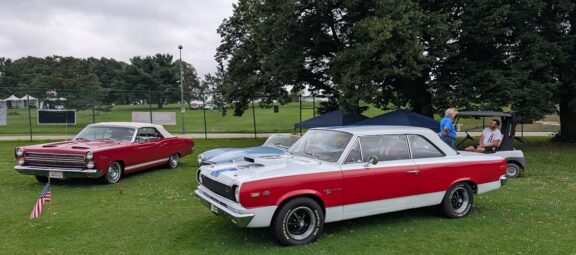
The donut sits untouched between us as rain threatens the Pittsburgh Vintage Grand Prix. Gregory Farrell politely declines – he’s watching his weight – but his enthusiasm for the red, white and blue Rambler parked nearby is anything but restrained. This is a man who has found his automotive soulmate in one of Detroit’s most unlikely muscle cars: a 1969 AMC Rebel.
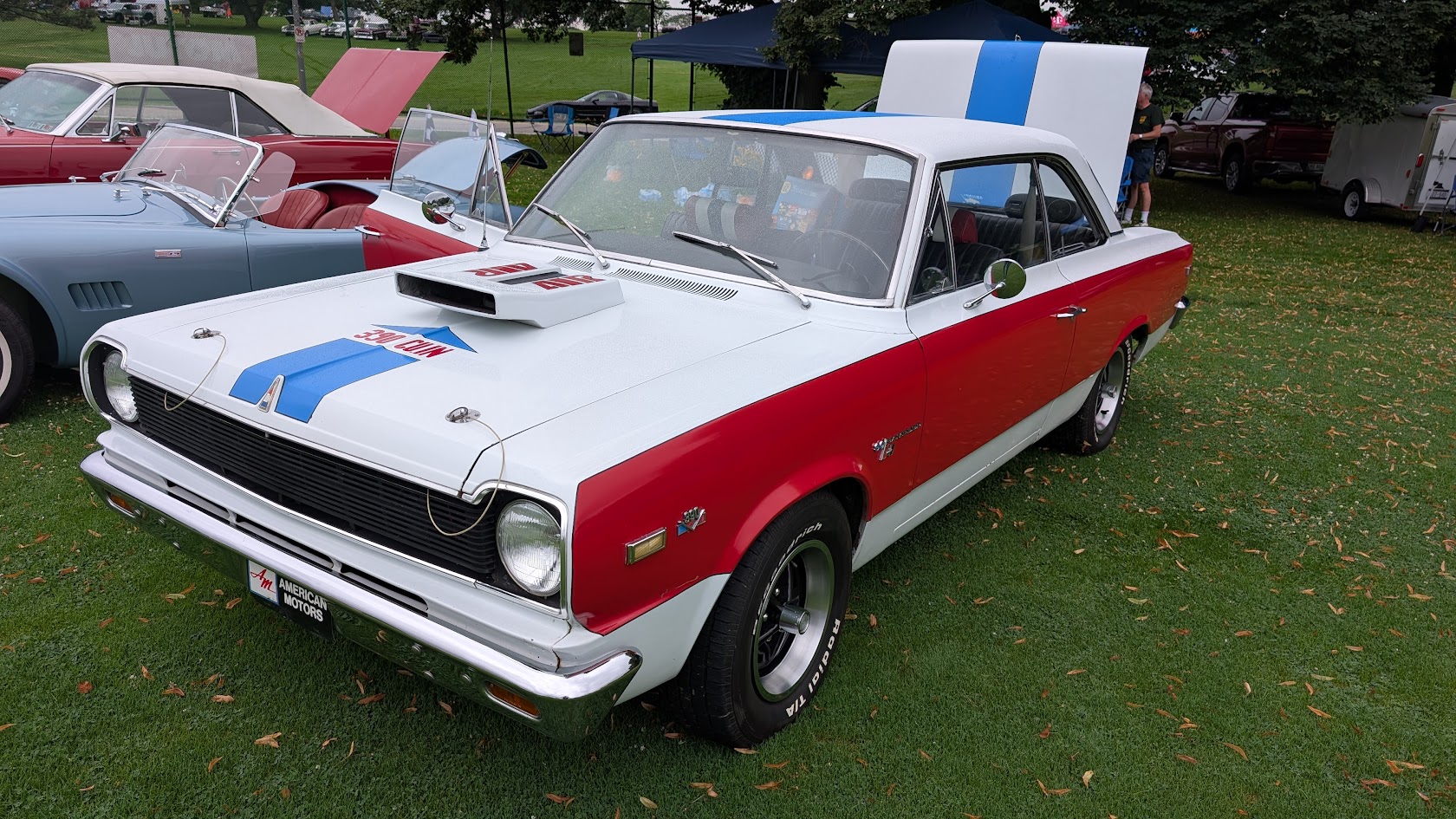
For most Mopar® enthusiasts, muscle car mythology centers around the usual suspects – Challengers, Barracudas, GTXs and Chargers. But for Greg and a small but passionate community of believers, the American Motors Corporation’s flirtation with high-performance remains something special. The Scrambler, with its audacious red, white and blue paint scheme and improbable combination of economy car chassis and big power (for the time), represents everything that made the muscle car era wonderfully ridiculous.
Standing close to this car evokes instant nostalgia for me – fumbling through Hot Rod magazines as a six-year-old, discovering the Rebel ad with its “Up with the Rebel Machine” slogan (I know, I know – this was the slogan attached to the 1970 Rebel, but… it’s what first made me pay attention to these cars way back when), falling instantly in love with the red, white and blue paint scheme, the four-speed, the 390 V8 and that wonderfully weird hood scoop. These cars imprint themselves on young minds and never let go!
In the late 1970s, before Google could summon information instantly, Greg’s dad told him stories about AMC’s real muscle cars – not just the Javelin, but a little Rambler American with a huge engine, dressed in the most preposterous paint job imaginable. For a young car enthusiast, this sounded almost too good to be true. Fast forward several decades and Greg found himself scrolling through a Facebook group dedicated to Scramblers. “If you want to stay away from alcohol, don’t go to the bar,” he jokes. “If you want to stay away from cars, don’t get on Facebook.” When this particular car appeared in a Hemmings listing someone shared, it caught his attention immediately.
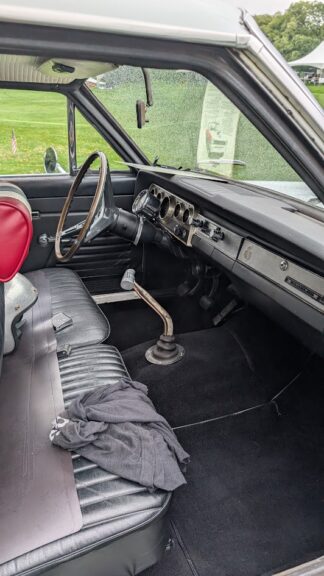
But Greg wasn’t looking for a concours-quality restoration. He’d already been down that road with his father’s 1978 Mercury Marquis – a four-door sedan that underwent a six-year, body-off, nut-and-bolt restoration, earning AACA Grand National honors. “When it was that nice, it was no fun,” he admits candidly. “You’re scared of driving it. I realized I love number three cars.”
This philosophy separates Greg from many collectors who chase perfection. He wanted a Scrambler he could actually drive, not a museum piece that made him anxious every time he turned the key. He found a pristine, unrestored, 24,000-mile car with original hose clamps – spectacular, but not for him. Then came the car that would become his: a driver with some brilliant non-stock additions.
When Greg showed his wife the listing for this particular Scrambler, her response sealed the deal in the most unexpected way. The car had been repainted in 1983 for $650 plus tax – a figure that wouldn’t even cover spray paint today – and featured black wheels instead of the factory-correct blue. “Would you keep the wheels black?” she asked. When he confirmed that he liked them better than blue, she gave her blessing.
Now, when purists approach him at car shows to inform him that Rebel wheels are supposed to be blue, Greg has his answer ready: “My wife likes black wheels.” The conversation immediately shifts. “They say, ‘Oh, your wheels are supposed to be black,'” he laughs, then responds, “Thank you very much.”
This imperfection – this deviation from absolute correctness – is precisely what allows Greg to enjoy the car without anxiety. The basic character remains intact. Someone looking at it feels like they’re seeing what it’s supposed to be, just lived-in and loved.
The Scrambler’s history made it even more appealing. The previous owner, who restored it in the early 1980s, bracket raced it extensively through the ’80s and ’90s. This wasn’t a racecar built from scratch – it was a car that someone raced, a crucial distinction in Greg’s mind. This was not a purpose-built drag car. I could hear in his voice why he liked the car and its original owner, “He kept it nice and raced it.” You have to love that.
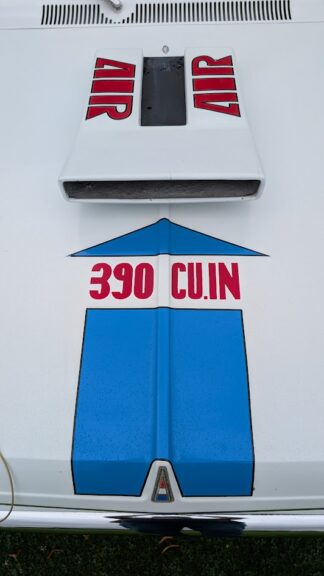
What’s under the hood? Well… it’s not a numbers-matching 390, but an AMC 360 from a wrecked Javelin – a thoroughly unremarkable two-barrel engine from 1971 or 1972. Yet this humble powerplant, which has never been apart and still wears its original heads, powered the car to a best quarter-mile time of 12.7 seconds. Stock Scramblers managed 14.3.
The modifications are straightforward but effective: the right cam, a large carburetor that everyone says shouldn’t work but does, heavy valve springs, big headers and 4.10 gears. That final ratio created a problem – 3,050 RPM at just 60 mph. “Are we there yet?” Greg jokes. The solution was a heavy-duty five-speed from G-Force, with gears one through four mimicking the original transmission and a 0.59 overdrive fifth. Now the Scrambler cruises comfortably at 80 mph on the turnpike, though Greg questions whether a 1969 Rambler suspension should really be trusted at those speeds for longer drives.
What truly makes this story special isn’t just the car – it’s the community Greg has found through it. The American Motors world represents a niche within a niche. There’s no convenient catalog, no vast NOS platform. Finding parts means knowing a guy who knows a guy and building a network of fellow enthusiasts who understand the struggle.
In 2019, Greg attended a reunion at Gordy’s, an old American Motors dealer who hosted an annual Labor Day AMC party. Thirty-eight Scramblers gathered in one place – a sight that left grown men giggling and pointing like children. “If you see one every three or four years, you’re doing pretty good,” Greg notes.
He and a friend now host the Pittsburgh AMC get-together in Greg’s yard each year, drawing 50 to 60 cars. When someone asked about parking their Camaro with the other cars, Mr. Farrell had to gently redirect them. “It’s not your day, dude,” he explains. “American Motors never gets their day. This is the one event a year that drags them off of jack stands and gets them rolling because they know they won’t be looked at like the red-headed stepchild.”
That phrase – red-headed stepchild – captures the essence of AMC’s place in automotive history. These were the cars that competed against GM’s and Ford’s billions while operating on a shoestring budget. The Scrambler’s flashy appearance came not from expensive fiberglass body molds like Carroll Shelby used, but from creative paintwork and some red, white and blue headrests. AMC made the Rebel look sensational.
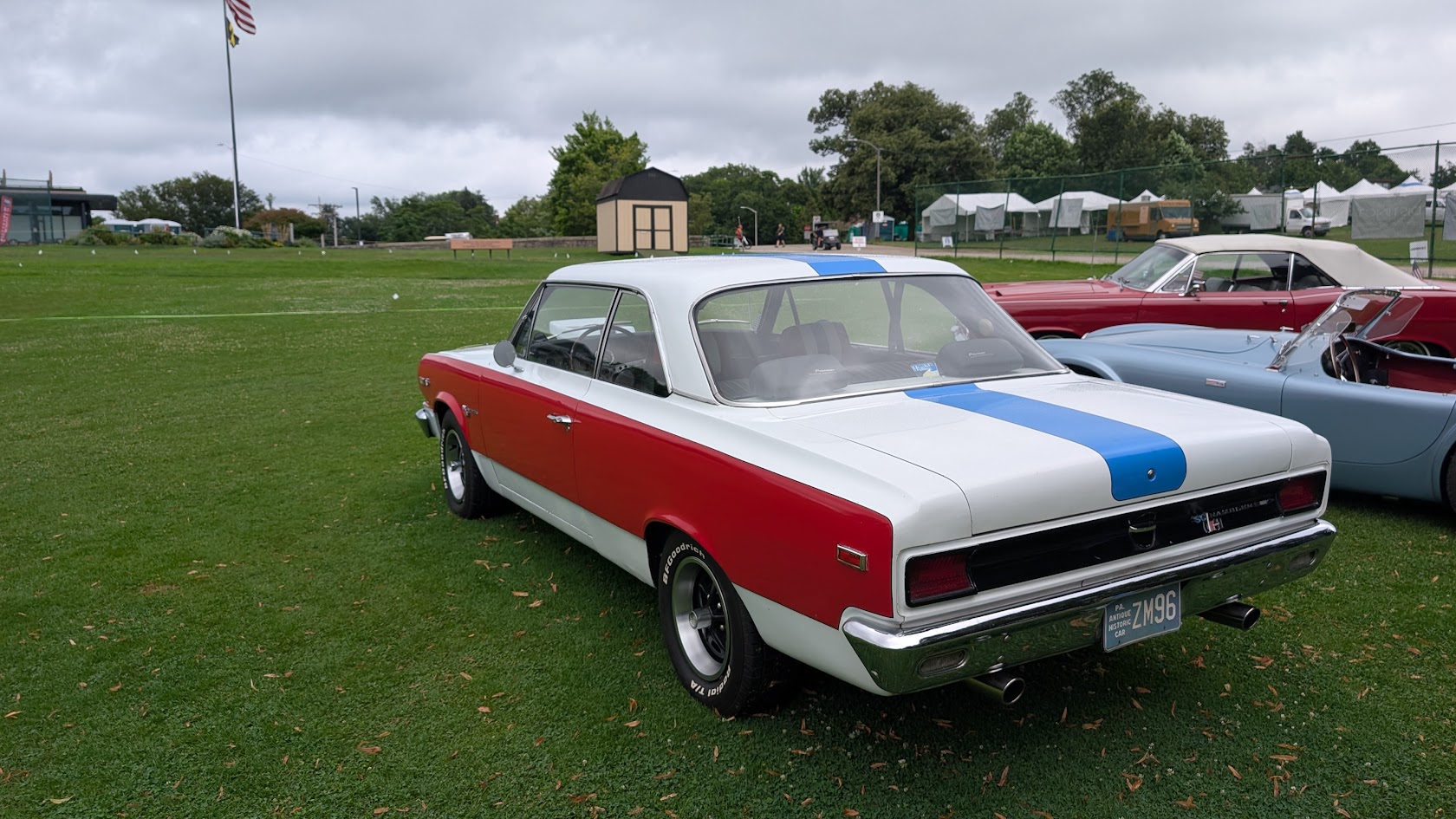
The Scrambler’s DNA connects directly to Dodge’s muscle car philosophy. Like the Dart and Demon, the Scrambler took an unassuming economy platform and stuffed in the biggest engine that would fit, creating something that looked improbable but performed brilliantly. The 1969 Scrambler led to the 1970 Rebel Machine – essentially the same formula in a slightly larger package – and eventually influenced the 1971 Hornet SC/360, an underappreciated giant-killer that weighed almost nothing and packed serious punch.
These were muscle cars for people who didn’t want the obvious choice, who appreciated engineering creativity born from necessity rather than unlimited budgets. In that way, AMC’s performance efforts mirror Mopar’s scrappy approach to going fast – make it light, make it powerful and don’t worry about the polish.
Craig drives his Scrambler weekly to work in the suburbs. It’s going to Kenosha, Wisconsin, next weekend for the massive AMC meet that happens every three years – an eight-hour journey he’ll make in his Navigator towing the Rambler. However, he’d have zero hesitation driving it if circumstances required. This isn’t a trailer queen or a show pony. It’s transportation, entertainment and rolling history.
Real. Not a time capsule or a dramatically sealed museum piece, but a car that was driven to high school in the 1980s, had a stereo installed because who doesn’t need music, was raced on weekends and was enjoyed thoroughly. It’s a car with a story, with patina that means something, with imperfections that grant permission to actually use it.
“I’m incredibly attracted to red-headed stepchildren,” Craig admits with a smile. “And I’m fine with that.”
In a world of predictable muscle car choices, that attitude – and this Scrambler – are refreshingly honest.
0 Comments