Just Lenny Being Lenny
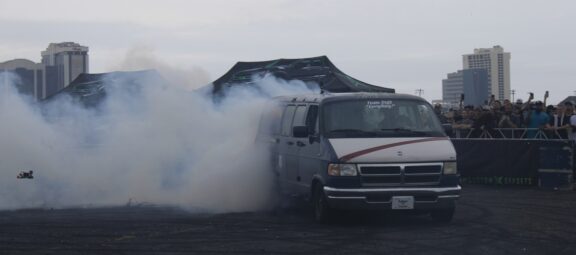
Some automotive enthusiasts collect cars; others restore them. Lenny from Route 5 Motorsports has taken a decidedly different approach throughout his decades-long relationship with Dodge brand vehicles: build them wild, drive them harder and if they survive the abuse, build them even wilder. His current drift van represents the culmination of a journey that began with one of the most outrageous street machines ever to terrorize parking lots – and somehow, it’s gotten even more extreme from there.
Long before drift culture made sideways driving mainstream, Lenny was perfecting the art of automotive chaos with a 1979 Dodge Power Wagon that defied every convention of what a pickup truck should be. The ’79 was special – the only year with quad headlights – but Lenny’s vision extended far beyond factory specifications.
Starting with a Ram Charger that had met an unfortunate end, he performed surgery that would make Dr. Frankenstein proud. “I cut the windshield section and the roof out and welded it together,” he recalls. The result was an unboltable factory-looking convertible top on a regular cab short bed – a combination that Dodge never offered but made perfect sense in Lenny’s world. Under the hood lurked a 413 wedge engine transplanted from his 1964 Chrysler, pumping out enough HP to make mothers pull their children off the streets as the truck thundered by. The drivetrain was equally unhinged: a four-speed connected to a gear-driven transfer case, feeding power to Dana front and rear axles, both equipped with lockers and 4.10 gears.
But the truck’s party tricks were what made it legendary. During the heyday of Street Machine Nationals in the ’90s, Lenny would use light poles as pivot points for donuts, the truck’s massive push bumper – a heavy-duty unit borrowed from a tow truck – grinding against the metal posts in showers of sparks. Even more memorably, he’d put the truck in reverse, dump the clutch and drive backwards across parking lots, the front bumper scraping against asphalt and sending up spectacular displays of sparks and smoke.
“That was one of my craziest ones I’ve ever built,” Lenny reflects, though the truck’s reign of terror ended when it was stolen – a fate that seems almost anticlimactic for such a legendary machine.
The Power Wagon established Lenny’s automotive philosophy: function follows fun, and conventional wisdom is merely a suggestion. This approach carried through subsequent builds, each pushing the boundaries of what constituted reasonable vehicle modification. His garage became a laboratory for experiments in semi-controlled automotive chaos, with each project teaching lessons that would inform the next.
The transition from four-wheel burnout machines to dedicated drift builds represented a natural evolution. Where the Power Wagon excelled at straight-line smoke shows and parking lot donuts, the van would master the art of sustained sideways motion – a more refined form of the same fundamental impulse to make tires disappear in clouds of smoke.
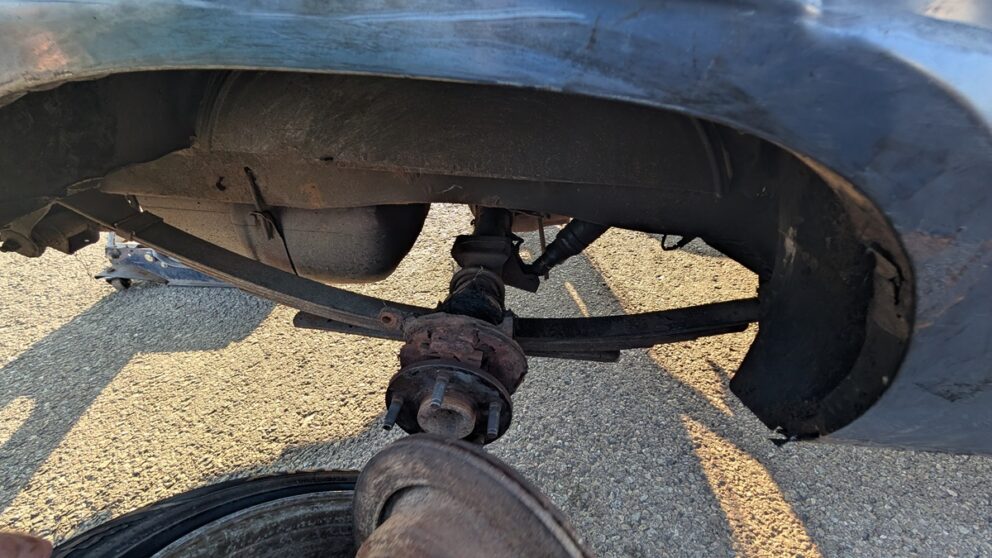
Lenny’s current drift van carries the DNA of every outrageous build that preceded it, refined through countless sessions of tire-shredding experimentation. The van features a flipped rear axle, transforming its handling characteristics in ways that conventional suspension setups simply can’t match. This isn’t just modification; it’s automotive alchemy, turning a humble cargo hauler into a smoke-generating, crowd-pleasing drift weapon.
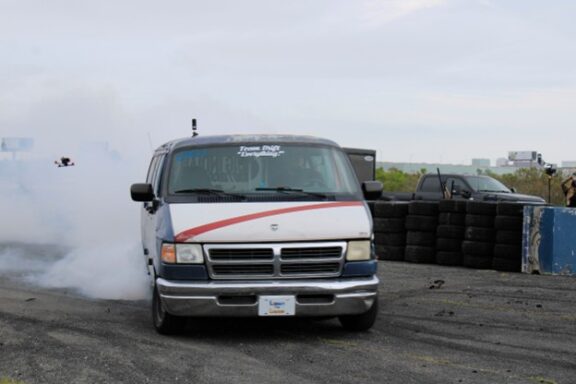
The mechanical choices reflect years of experience doing exactly the opposite of what most folks would expect to work. With no rear brakes whatsoever, every drift session becomes an exercise in pure throttle control and steering input. It’s a setup that demands total commitment from the driver and delivers total entertainment for spectators. “Everything’s been tested,” Lenny explains, noting how this van served as a proving ground for concepts he’d later implement in future builds.
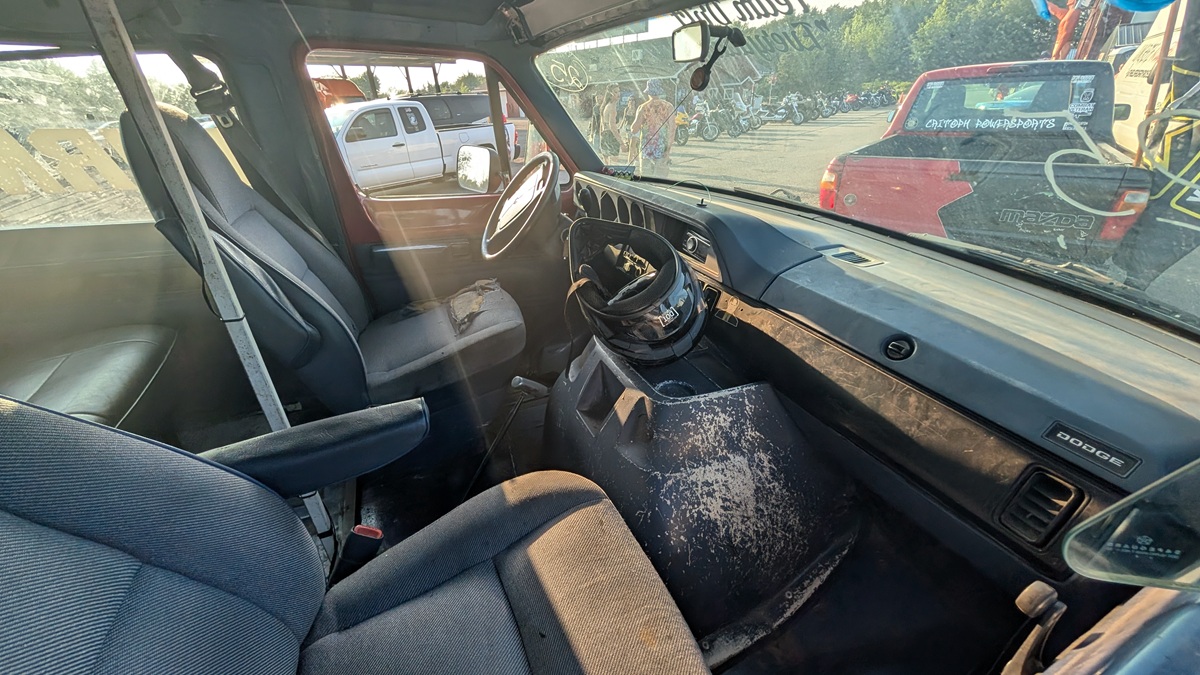
Street driving the current van requires a masochistic dedication to the craft. “You can’t drive down the road, it’s horrible,” Lenny admits with characteristic understatement. “You run over an ant, and you bounce three feet into the air.” When the van was still equipped with a manual transmission, every red light became an impromptu performance as the engine screamed against the rev limiter while bewildered pedestrians wondered what automotive apocalypse was unfolding.
The van’s reputation has spread throughout the burnout and drift communities, leading to invitations to prestigious events. At Burnout Nationals, Lenny found himself running alongside the sport’s biggest names, including teams with Australian-built trucks sporting massive superchargers.
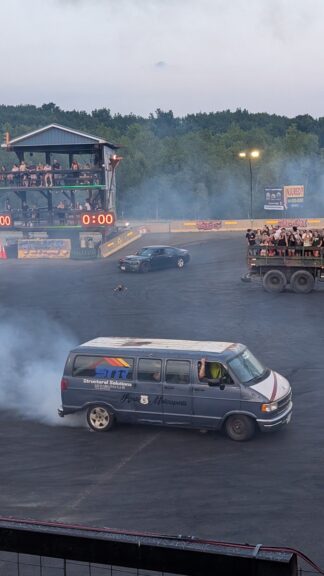
Each competition becomes both a performance and an endurance test. The van’s appearances at The Big Indian Drift Pit have made it a crowd favorite, its distinctive look and tire-shredding capabilities drawing attention from both competitors and spectators. Among rows of pristine muscle cars and carefully crafted customs, Lenny’s creation stands out with just the right amount of bonkers and a boatload of desire unleashed from the constraints of practicality or common sense.
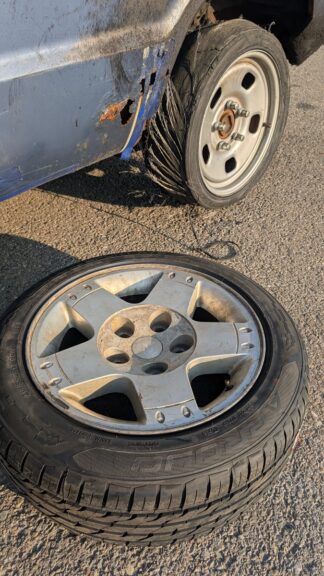
No stories better illustrate the van’s character than its road trip adventures. These journeys have become legendary for all the wrong reasons, each one pushing the boundaries of what constitutes reasonable transportation decisions. After one Syracuse event, the return journey on bald tires became an exercise in automotive Russian roulette. “I was waiting for a tire to explode for three hours on the way back without having anything to put on as a spare,” Lenny recalls. When disaster inevitably struck – two tire failures within ten miles – the solution was typically unorthodox.
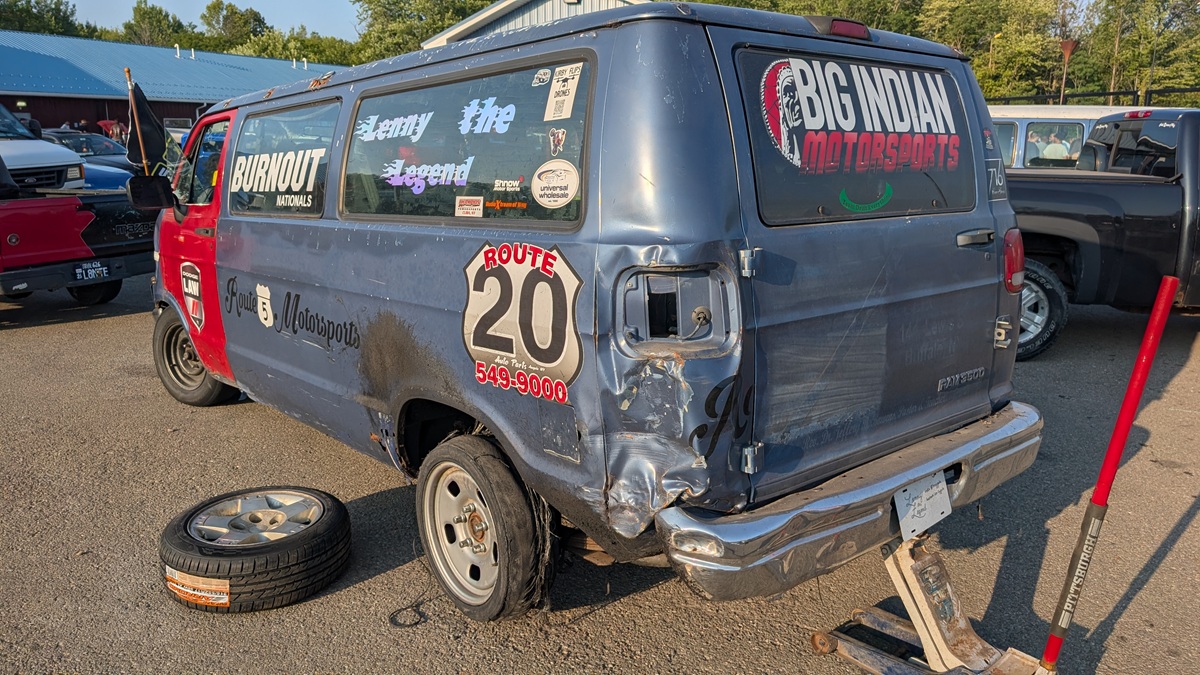
Using a floor jack positioned backwards in the van, they lifted the rear axle, then backed the tow dolly hard enough to knock the jack out and drop the van onto the dolly. The final sixty miles were completed backwards on flat tires at 3 AM, because apparently that seemed like the most reasonable option available.
The van’s compromised street manners extend to basic transportation logistics. The rear suspension setup leaves insufficient clearance for the back bumper and gas tank assembly when tires lose air pressure. “There’s not enough room without tire for the back bumper/gas tank to not hit the ground,” Lenny explains, making every tire failure a potential road-scraping adventure.
What emerges from Lenny’s automotive journey isn’t just enthusiasm – it’s a complete rejection of conventional wisdom about what vehicles should be and how they should behave. From the spark-throwing Power Wagon to the spine-jarring drift van, each build prioritizes spectacle over sensibility, function over form, but defines function in the most unconventional terms possible.
The van represents pure automotive performance art, if performance art involved destroying tires and potentially everything else in the immediate vicinity. It’s the logical endpoint of a philosophy that began with using light poles as drift anchors and continues with backwards highway travel on flat tires.
In a world increasingly focused on efficiency, builders like Lenny serve as keepers of a different flame – one that burns rubber and gasoline in massive quantities and values unforgettable experiences over practical transportation. His drift van isn’t just a competition vehicle; it’s a rolling manifesto declaring that sometimes the best automotive experiences come from the worst automotive decisions.
The journey from Power Wagon to drift van shows an evolution in technique but consistency in philosophy. Where others see limitations, Lenny sees opportunities for creative destruction. Where others prioritize reliability, he embraces spectacular failure as part of the entertainment value. Most importantly, where others build cars to be admired, Lenny builds machines to be experienced – viscerally, loudly and absolutely unforgettably.
0 Comments