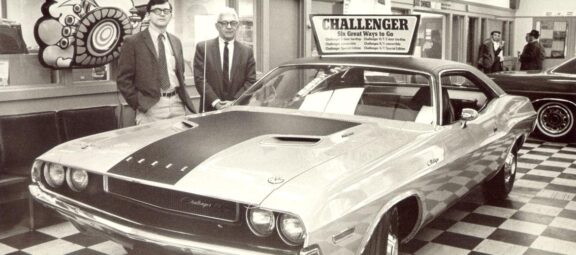
Presenting…the 1970 Dodge Challenger
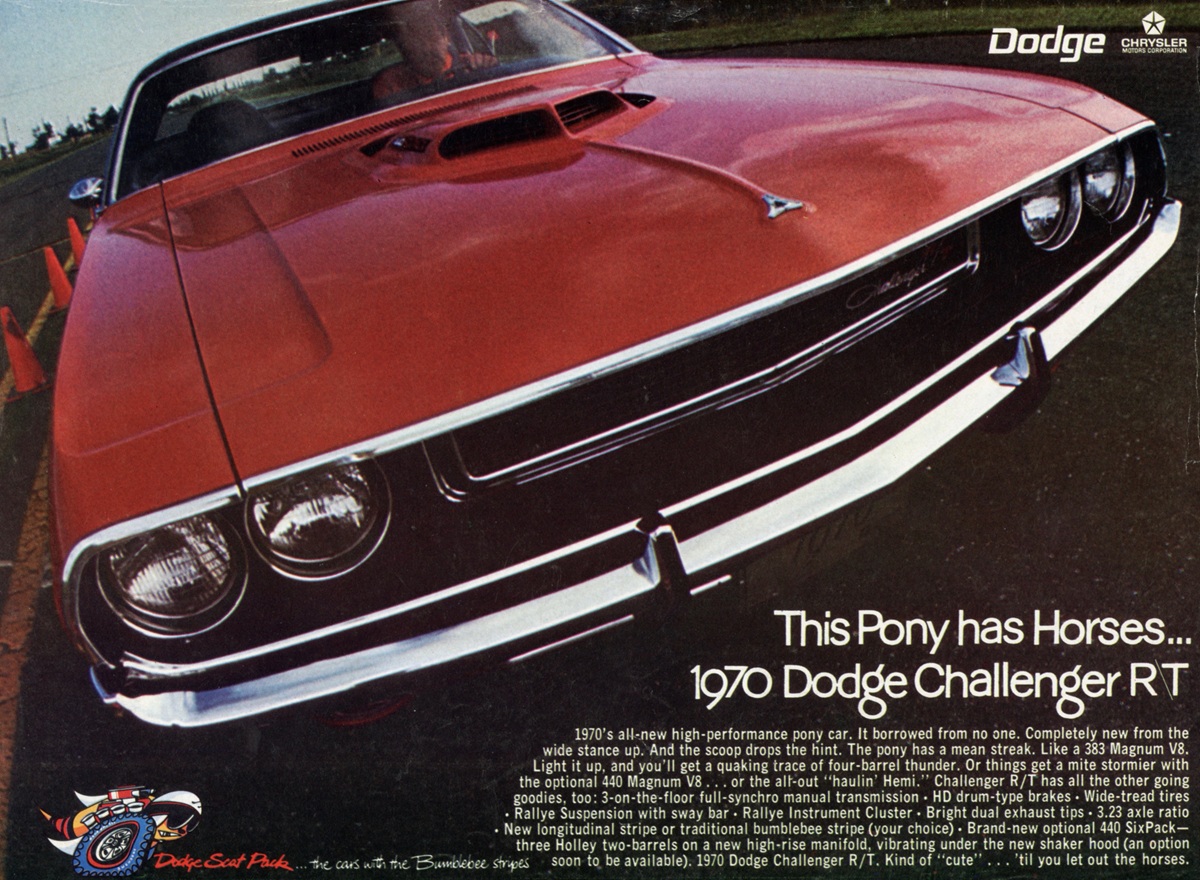
And that’s how the Challenger was introduced to the readers of Dodge News Magazine in the October 1969 issue. This publication was sent to current Dodge owners and only available through the network of Dodge dealerships, in other words, just select people had access to seeing the magazine. The editor wrote: “We’re proud of all the 1970 Dodge cars and trucks, and proud that you’re getting your first look at them in this magazine.”
Challenger was a big deal in and around the Dodge dealerships. At last, they had an entry into the pony car market (Mustang, Camaro, etc.) with this new model and it made a big splash in the official Dodge publication, with the first-ever published images. “Here it comes, the only new entry in the sports compact field. Gripping the road with a stance that says solid. Engine choices that run from the thrifty Six up to the incomparable 426 HEMI®. Nine models in all, priced to compete with the pony cars. Thicker, deeply molded doors off more side protection. Door handles, inside and out, are flush. Three tops available, Standard, a Special Edition (SE) with vinyl-covered formal roof hardtop, and convertible. All nine models feature concealed wipers, locking steering-wheel column, deep-pile carpeting, dual headlights and more.”
A MARKETING PUSH FOR WOMEN BUYERS
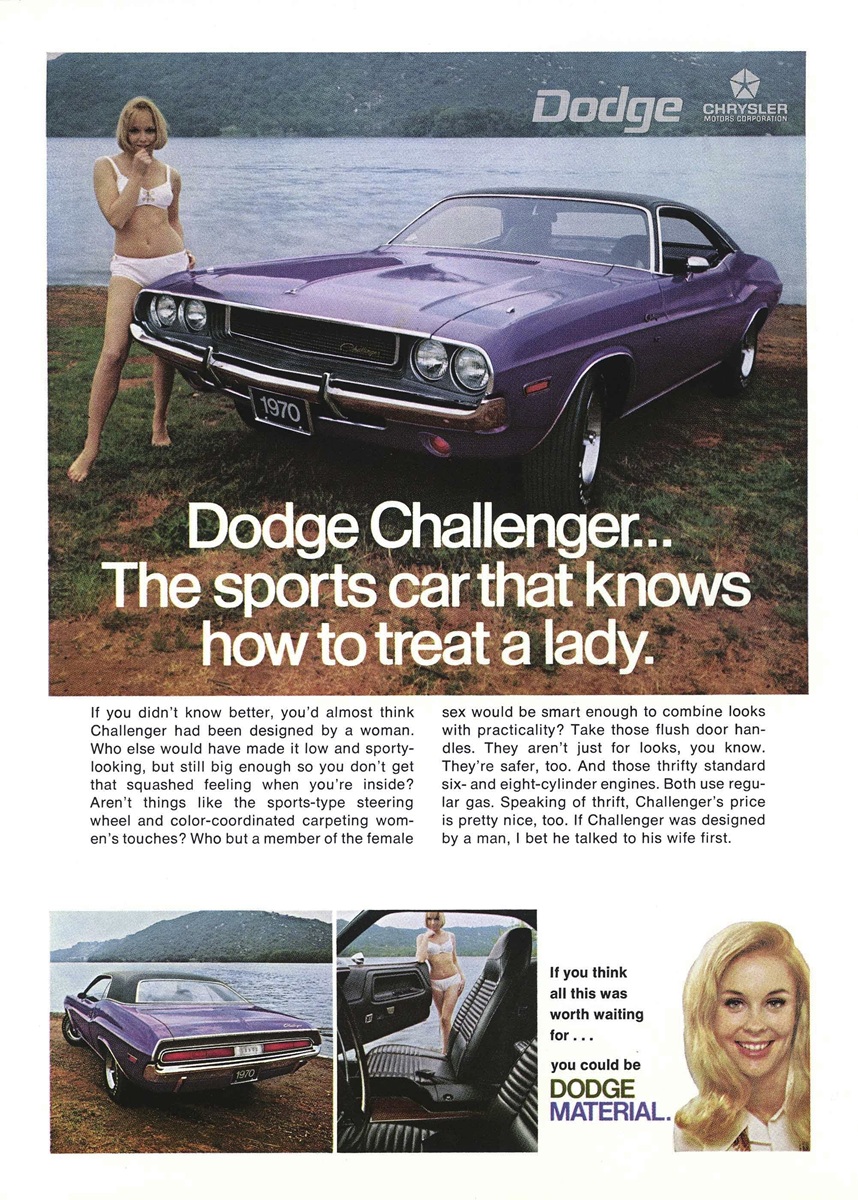
“The sports car that knows how to treat a lady.” That’s how this 1970 Challenger national magazine ad started out, and featuring a Plum Crazy, black vinyl top example car fitted with W23 Road Wheels and Goodyear Polyglas GT white lettered tires. The ad copy was focused on getting the message out that Challenger wasn’t just for the drag strip. “If you didn’t know better, you’d almost think Challenger had been designed by a woman. Who but a member of the female sex would be smart enough to combine looks with practicality? If Challenger was designed by a man, I bet he talked to his wife first.”
Also new for 1970 was the new “Dodge Girl” Cheryl Miller, shown at the lower right corner of the ad. Millions of TV viewers already knew her as “Paula Tracy” from the Daktari television show that aired on CBS from 1966-1969.
MAGAZINE ADVERTISING
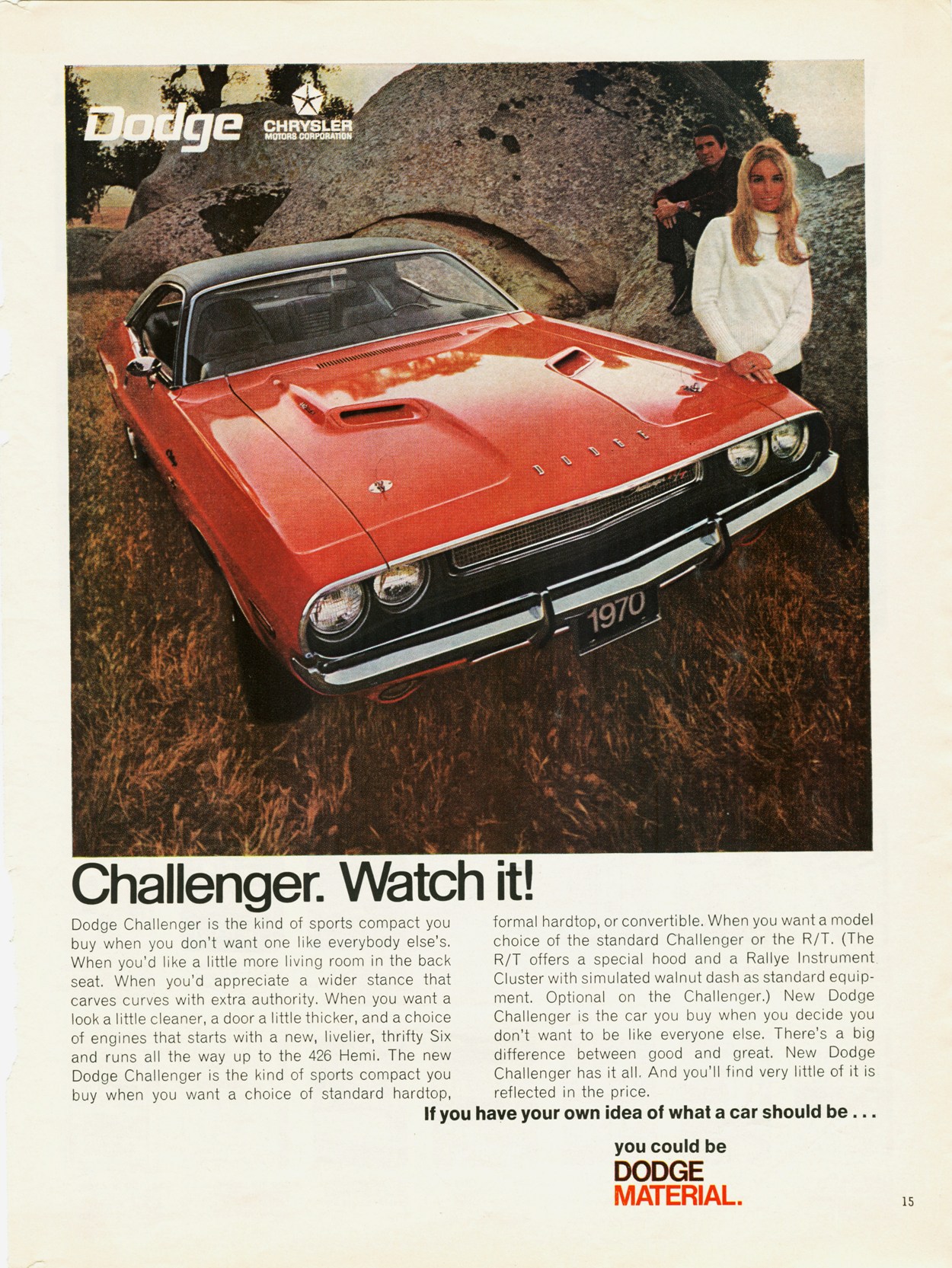
Dodge Challenger is the kind of sports compact you buy when you don’t want one like everybody else’s.
There was an extensive advertising campaign for Challengers and they were in the “buff” books (Car and Driver, Road & Track, Motor Trend, Car Life, Hot Rod, Car Craft and numerous others). And while many of them featured the higher performance R/T models, there clearly also was recognition for base Challengers, as the marketing people knew there was a lot out in the marketplace for 225-cid Six and 318 V8 buyers. The cool thing then and now about E-body Challengers, the body shape has that muscular shape to it no matter what is under the hood!
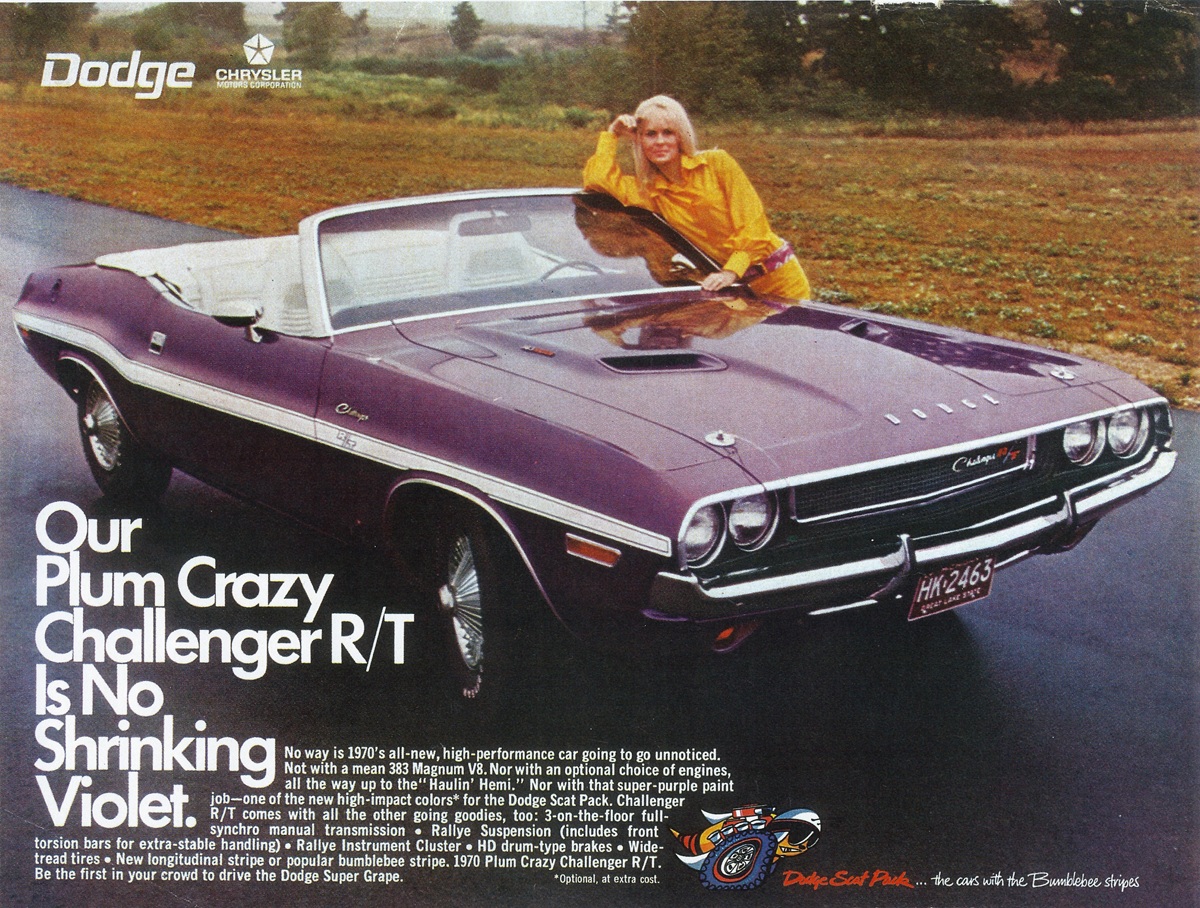
Plum Crazy paint was a natural to promote the new Challenger, a brand-new hue for the 1970 model year and it’s featured here on one of the Challenger convertible ads, an R/T white interior. Included on the car were the not-often-seen W14 optional wire-wheel-type wheel covers. “Dodge Scat Pack” was highlighted on the lower RH corner.
INSIDE THE DEALER BROCHURE
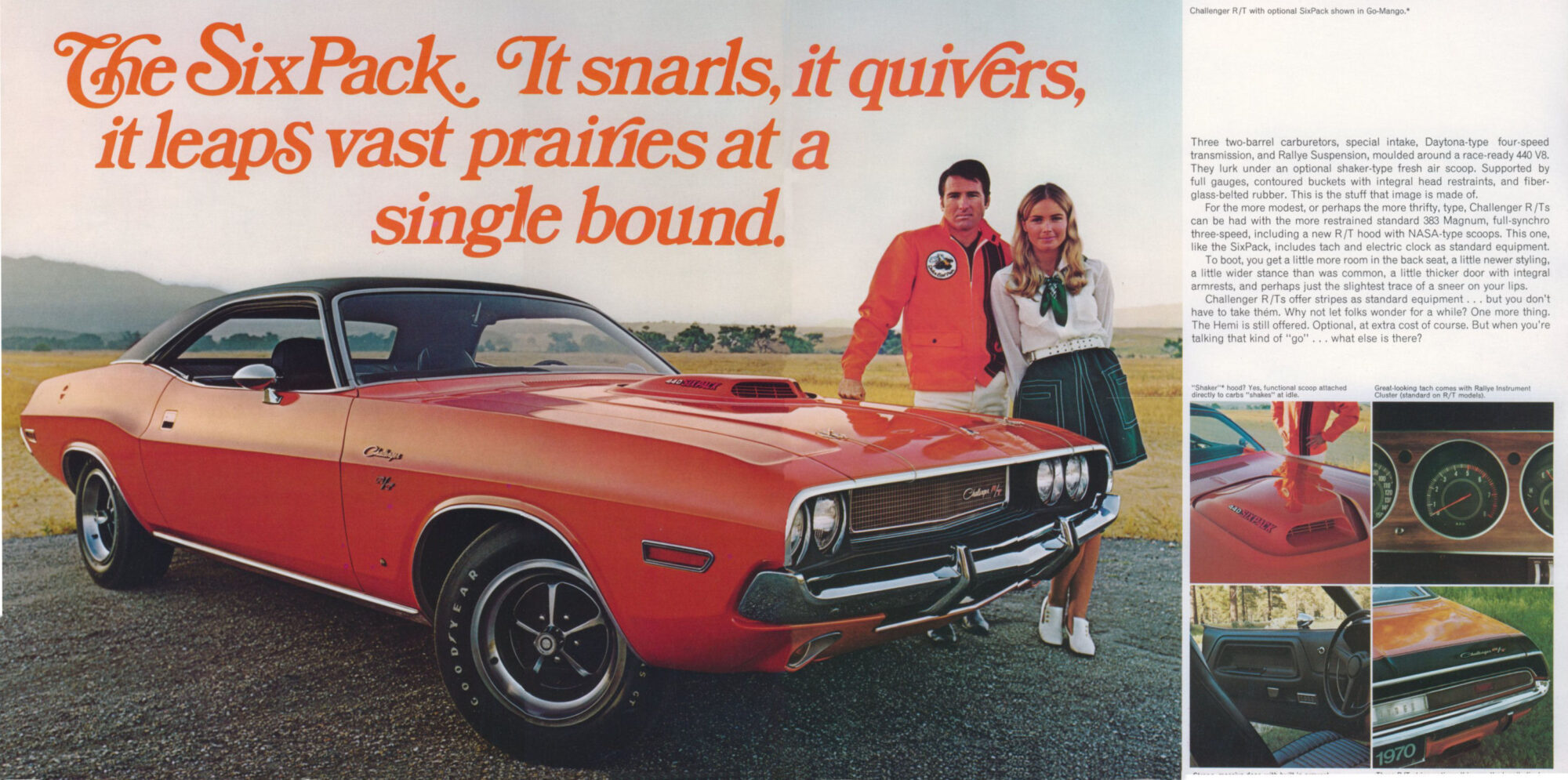
Go Mango, Bumble Bee Strip, 440 Six Pack, Shaker and W23 Road Wheels highlight this Challenger R/T.
“Three two-barrel carburetors, special intake, Daytona-type 4-speed transmission and Rallye Suspension, moulded around a race-ready 440 V8. They lurk under an optional shaker-type fresh air scoop. Supported by full gauges, contoured buckets with integral head restraints and fiberglass-belted rubber. This is stuff that image is made of.” Sometimes advertising people get a little overly “creative”, however in this case, in all actuality, no hyperbole!
HIGH IMPACT COLORS NEW FOR 1970
Adding to the Challenger excitement were the bright colors that were available at a cost of $14.05: Plum Crazy, Sublime, Green Go, HEMI Orange, Panther Pink, Go Mango and Top Banana.
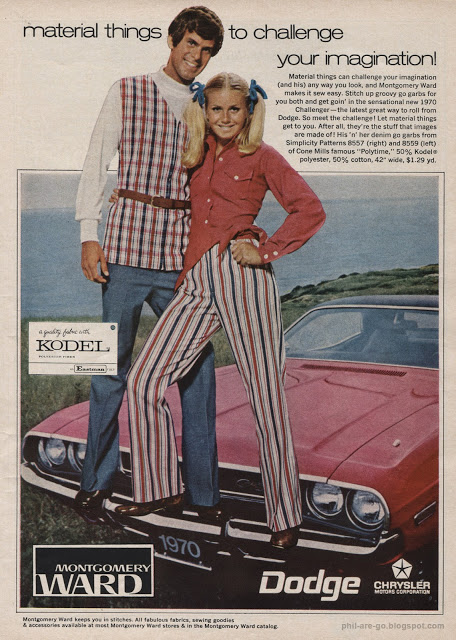
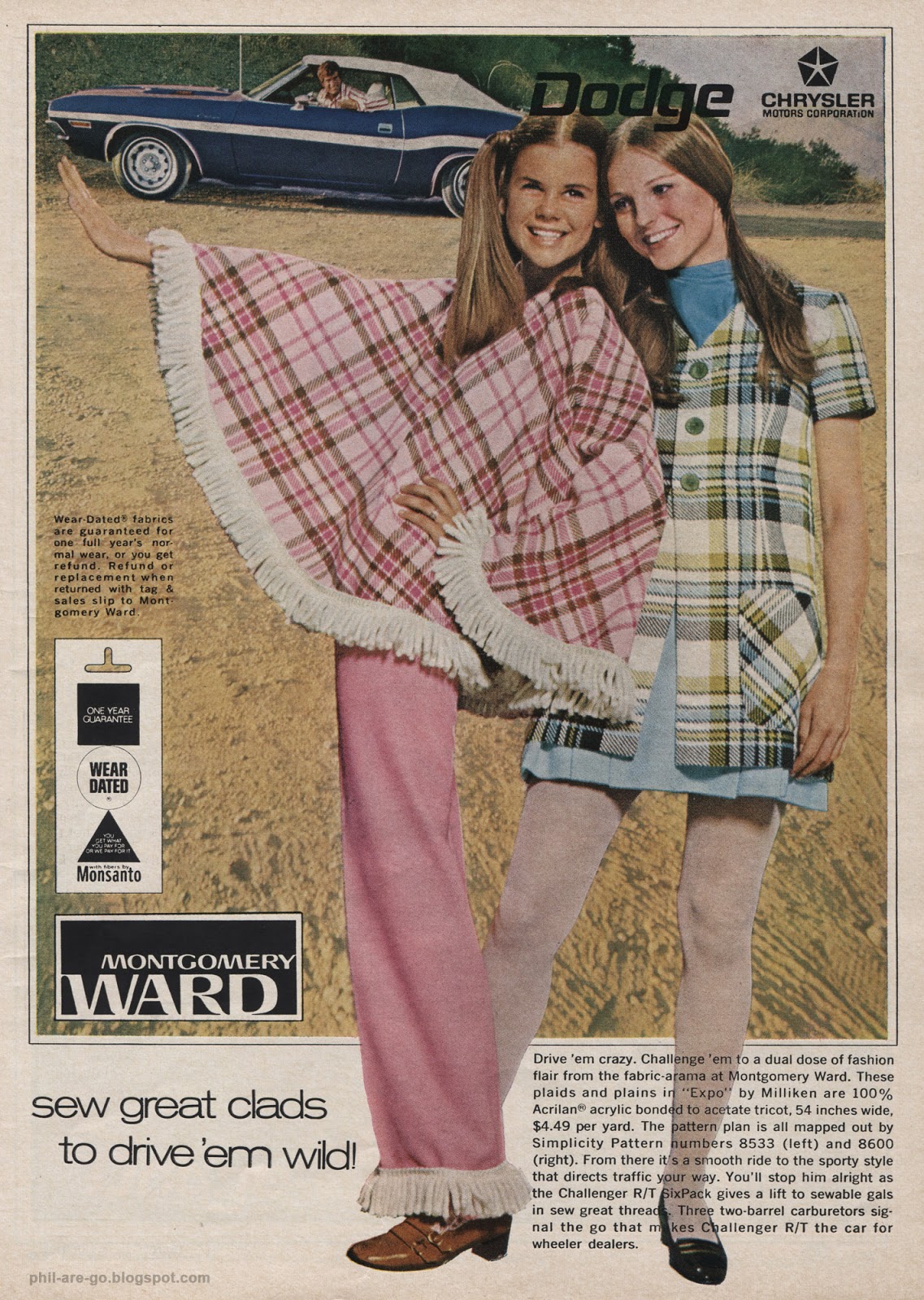
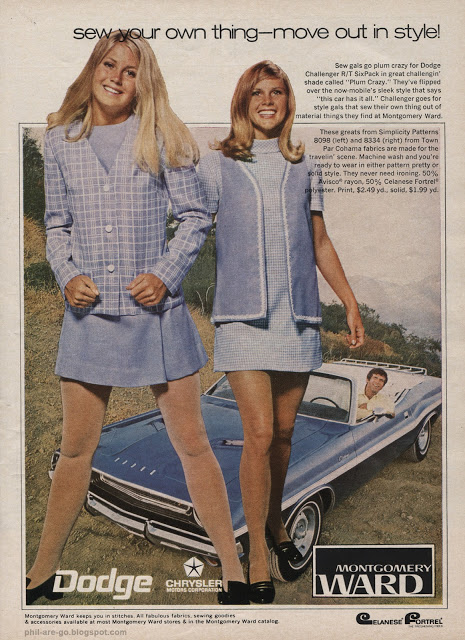
ADVERTISING CAMPAIGN WITH MONTGOMERY WARD
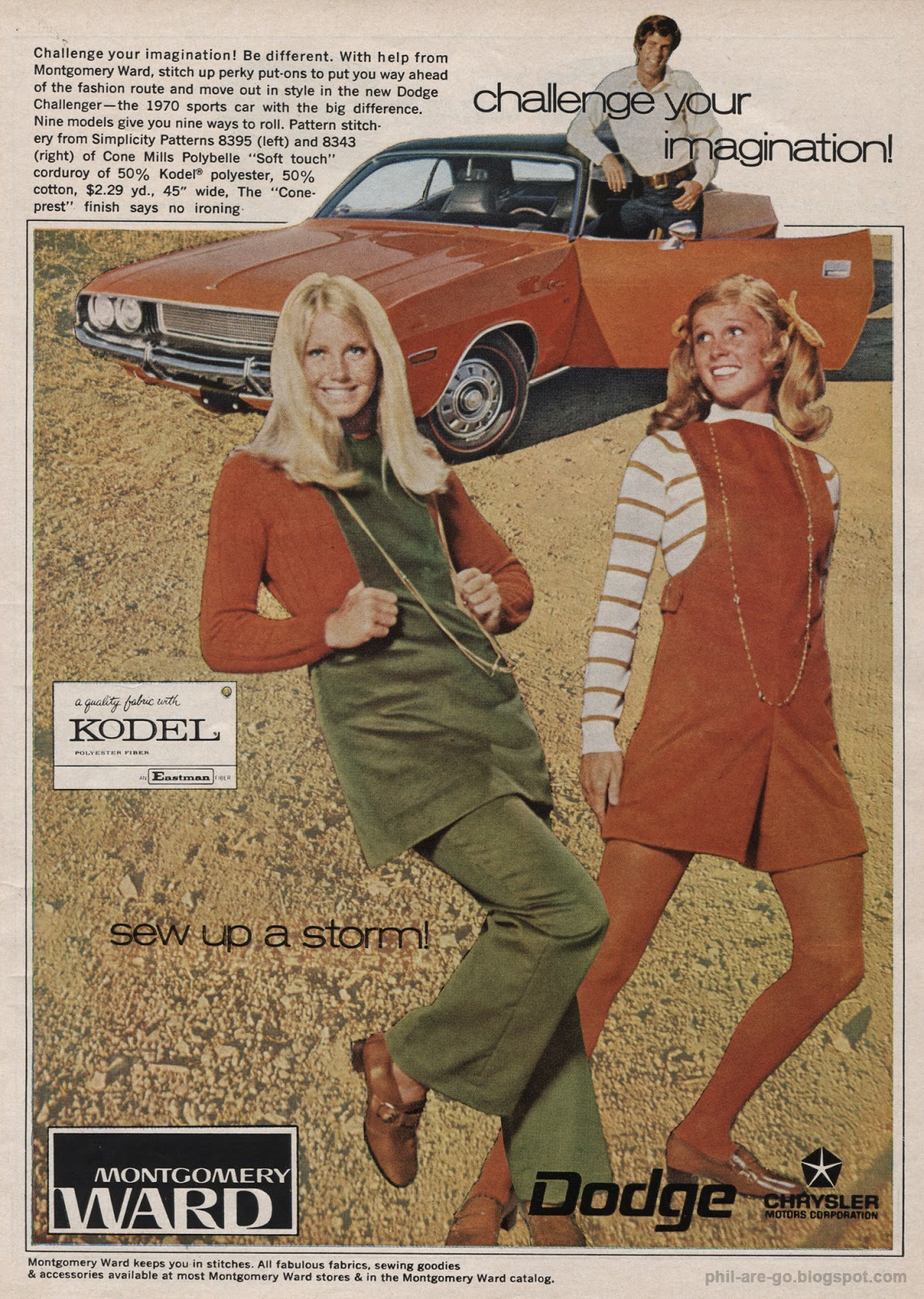
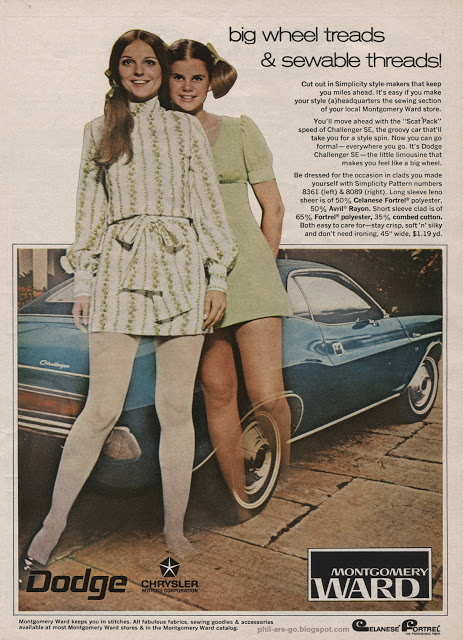
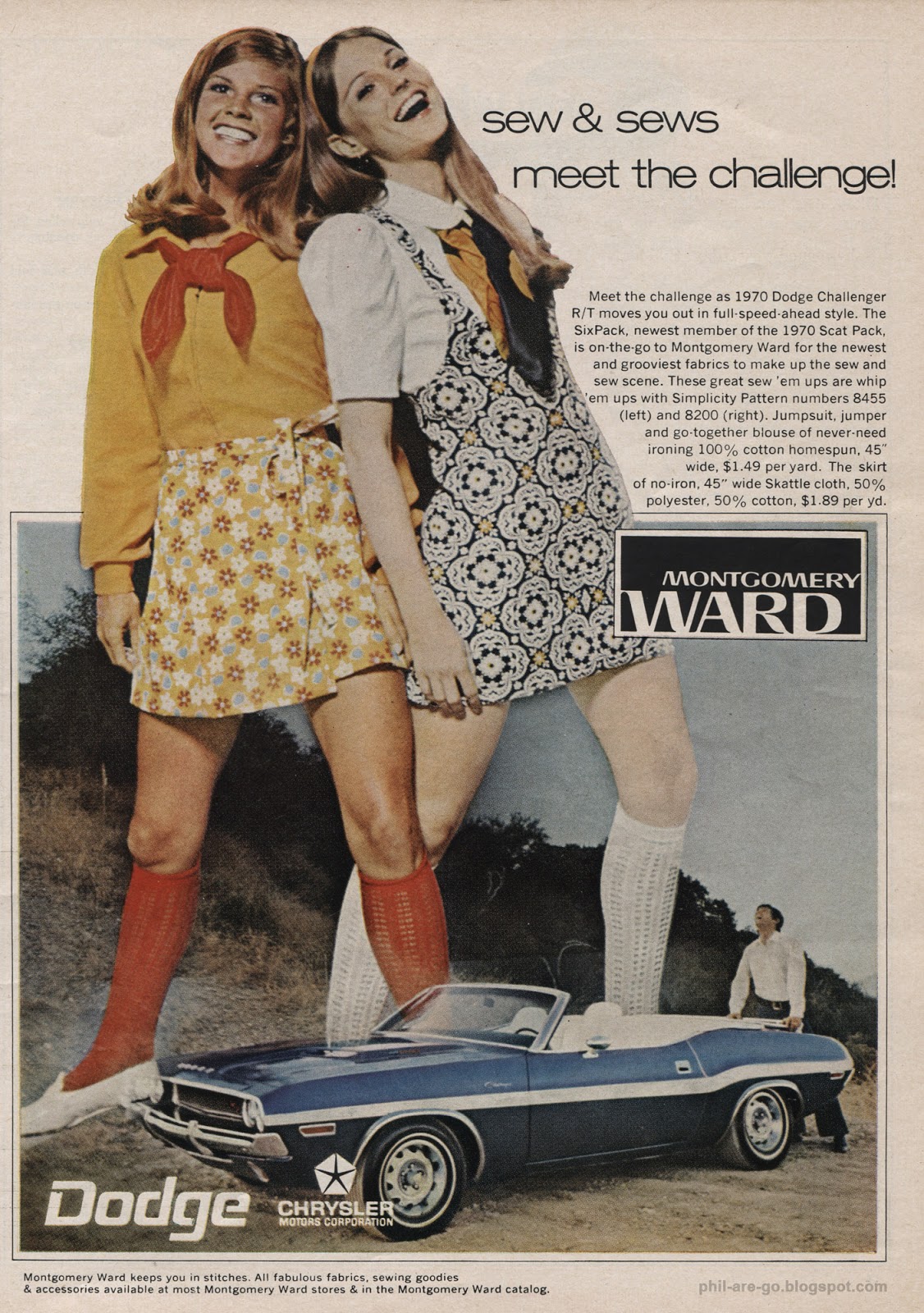
A series of colorful “cross-promotion” magazine advertisements were part of the Challenger launch, this group of ads that highlighted “fashion” in the way of sewing patterns (focusing on female clothing along with a “his & hers” combo) for those that stitch-up their own threads. Add in the standard, R/T and SE Challengers in a variety of colors and that made for a series of subliminal visuals.
AFTERMARKET WHEEL ADVERTISING
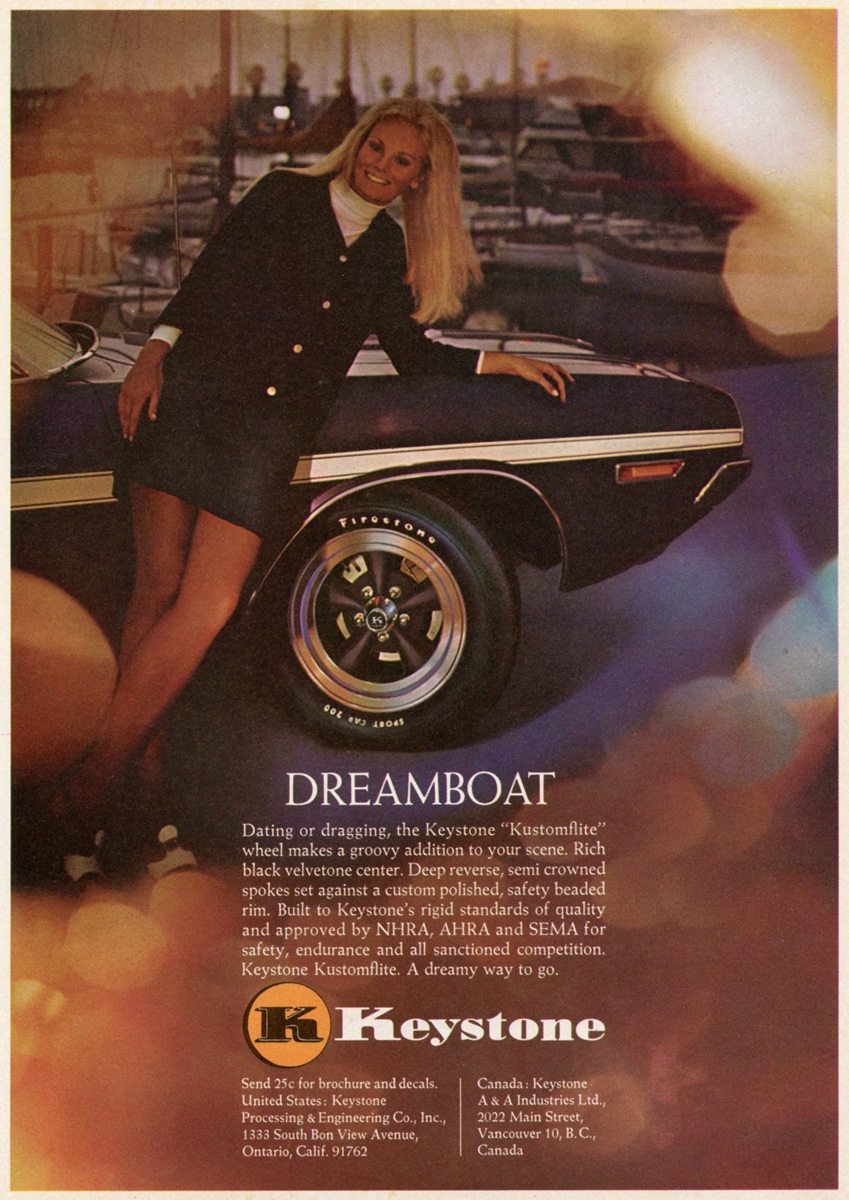
Right off the bat, the automotive aftermarket jumped on the featuring of 1970 Dodge Challengers in their magazine advertising. Case in point: when Keystone did up a full-page “DREAMBOAT” color ad for their new line of “Kustomflite” wheels (complete with black velvetone-applied centers), they chose an FC7 Plum Crazy R/T with White Longitudinal Tape Stripes. The lighting conditions provided the disc brake rotors to shine!
R/T VERSIONS THREE CHOICES FOR STRIPES
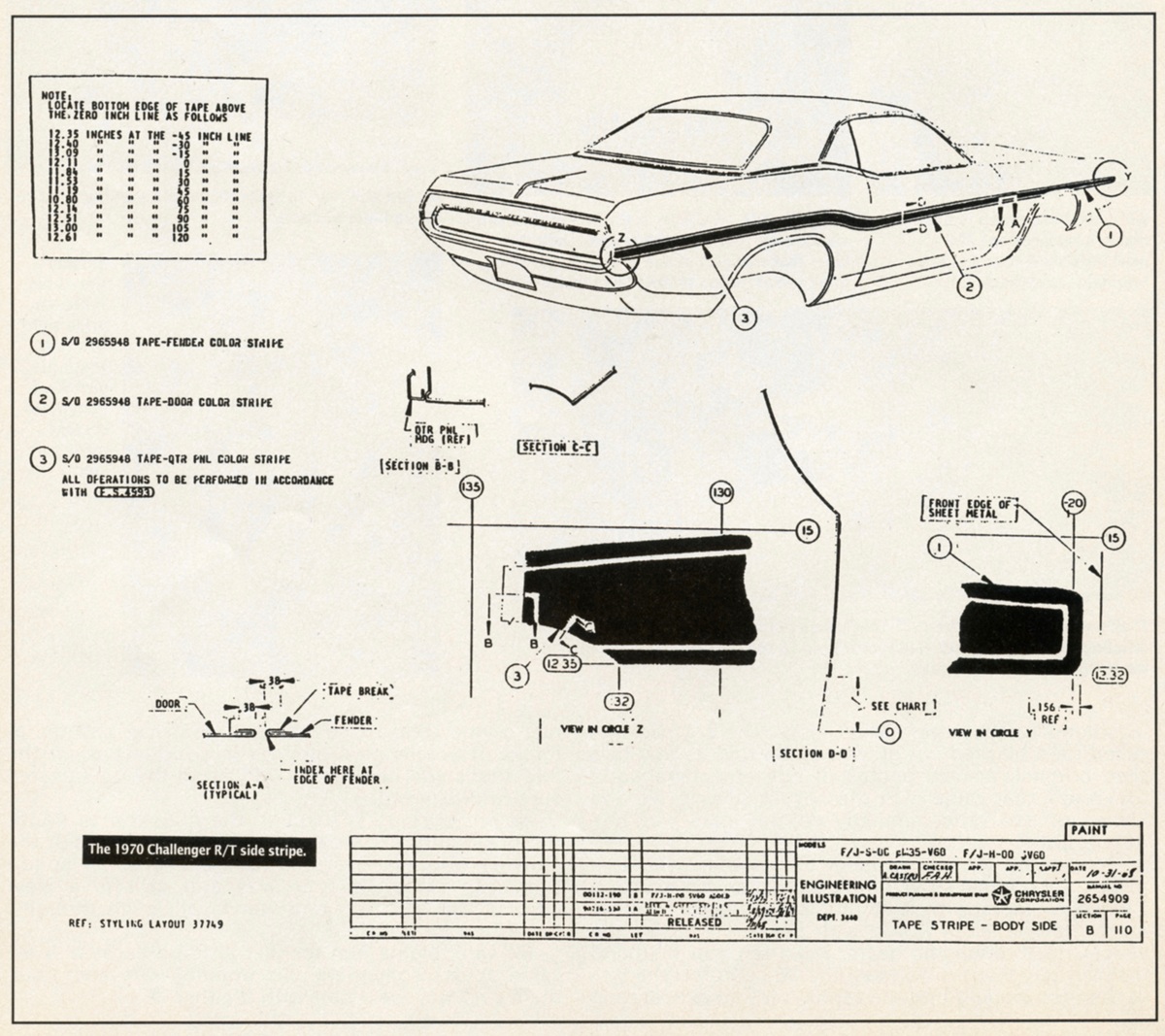
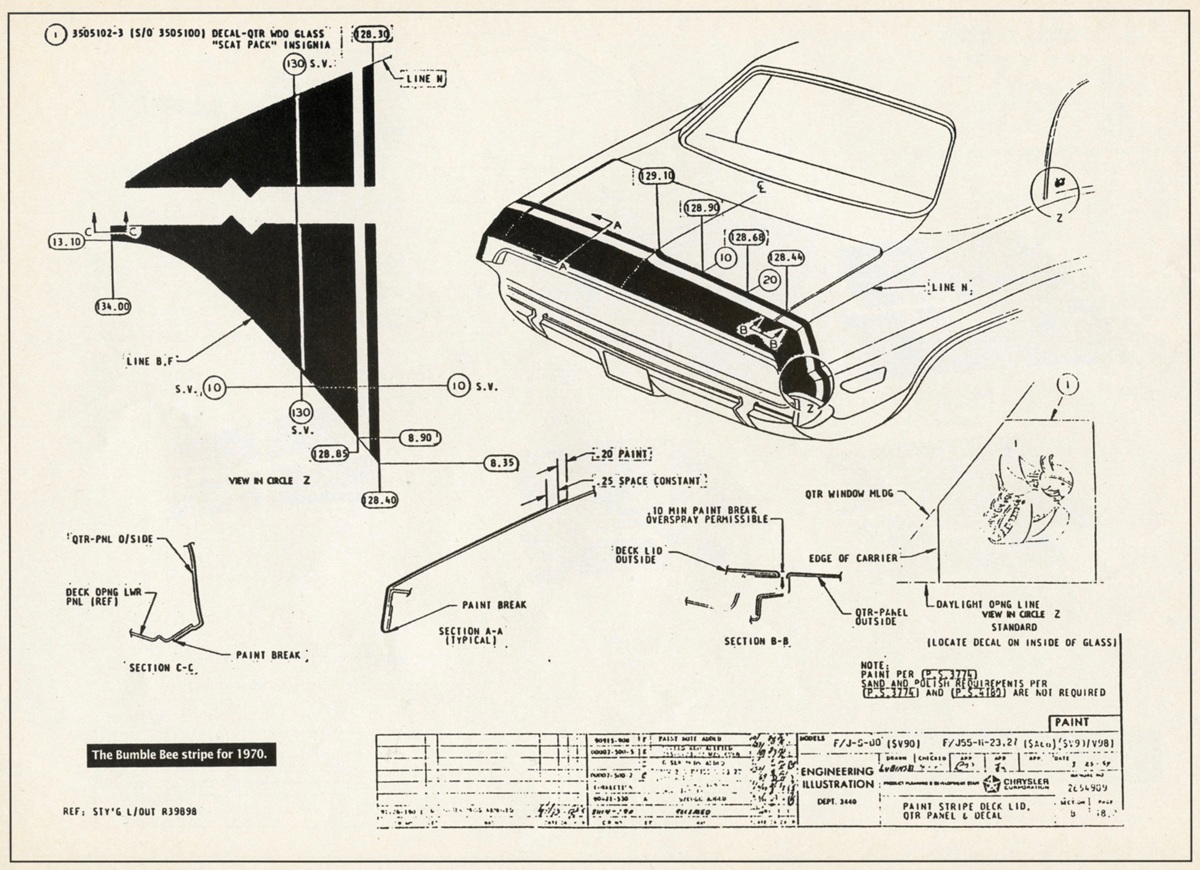
For buyers of Challenger R/T models, there were decisions to make! Besides the engine choices (9340, 383, 440-4, 440 Six Pack, HEMI), for outside appearance there were three choices: Bumble Bee stripe, Body Side Tape Stripes or no stripes at all (Stripe Delete). These engineering illustrations also include the Scat Pack insignia decal for placement inside the quarter window.
MEDIA RESPONSES
All the car mags did a review of the new Challenger. Motor Trend said, “The Challenger is styled for right now.” Editor Bill Sanders seemed impressed. “Our test car was an R/T–SE so we lucked out on everything. The dash has a good, overall layout. If you dig stereo, acoustics in the Challenger are great. It actually handled well considering all the extra weight hung on the front of the mill.”
Hot Rod drove one in their December ’69 issue and said, “Appearance is great from any angle,” and they pointed out a few flaws here and there, noting that it was a “very, very early model-run car” suggesting that it wasn’t built up to par as a result. At the mid-point of the article, editor Steve Kelly did point out “the Challenger did impress us,” and with that, it was explained that “someone in control of cars released for test that just any car on the lot should be shunted off” (to the magazines.)
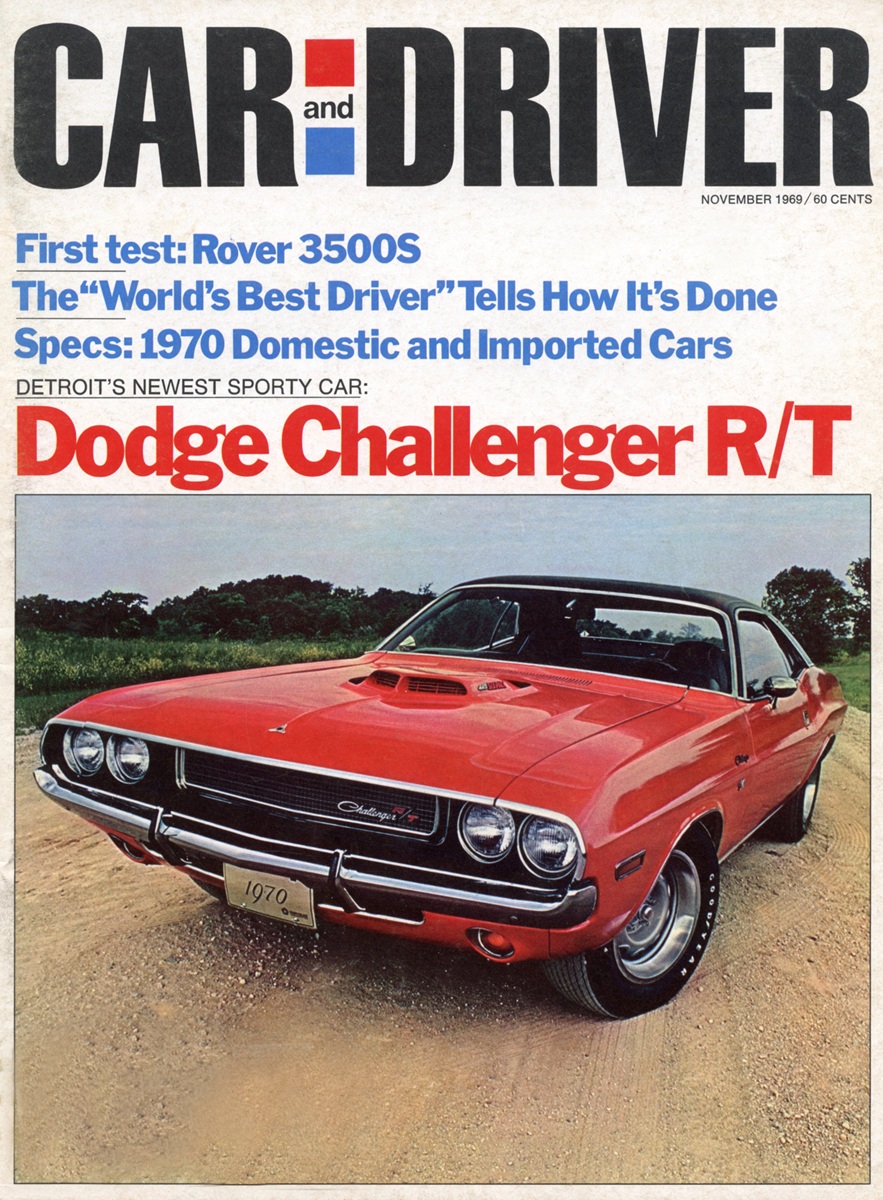
Even though the editors of Car and Driver magazine ran a HEMI Challenger on the cover of their November 1969 issue, they didn’t exactly provide the best reviews of the car. First off, their opening line was hardly anything to encourage readers to like the Challenger: “Lavish execution with little or no thought toward practical application.” Somehow, they missed the point that nothing with a Mopar® HEMI is considered practical. (That’s what the available 225-cid Slant Six was for). Also noted that with the HEMI engine the Challenger was “nose-heavy.” Really? These guys just didn’t get it. The Special Edition overhead console was “an excuse for the product planners to hang a piece of bright work on the headliner and thereby ‘create the impression of greater value’ when in reality it’s next to useless.” Talk about a buzzkill.
Well, they managed a 14.1-second time on the drag strip (3.23 rear gears and automatic). Among the complaints was one regarding the back seat, here’s their words: “Sitting back there, you still have no choice but to spread-eagle your legs around the the front seat backs.” The report went on and on about them being “disappointed” and ending up saying that “Dodge has had enough time to build a more purposeful car.”
If only it were possible to see the looks on their faces when over the years HEMI Challengers with rare options rolled across collector car auctions with people fighting over who can spend the most money on getting one of these rare E-body creations. It would be fair to say that nobody in late 1969 knew where the muscle car market was heading and that it all about about to end, but still, C&D really was beyond negative, it’s a wonder they ran it on their cover.
Well, perhaps it was said best in the lyrics of Joni Mitchell’s hit song “Big Yellow Taxi” from 1970: “Don’t it always seem to go, that you don’t know what you’ve got until it’s gone.” In this case, going to a dealer and buying a Shaker-scooped Go Mango 426 HEMI Challenger R/T SE in all its glory.
77,000 TOTAL SALES 1970
Challenger managed to out-sell the Mercury Cougar that year; however, the corporation had originally forecasted more than double: 200,000
YELLOW JACKET
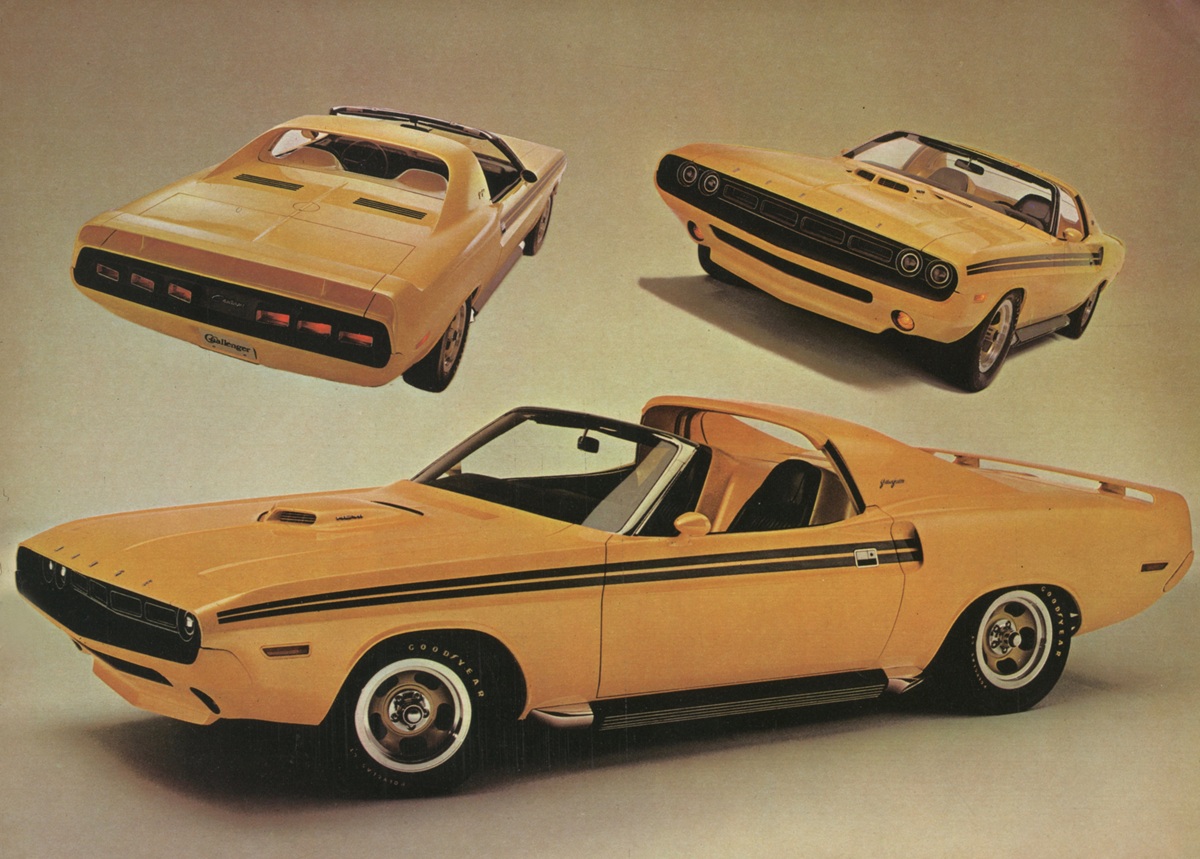
During 1969, the national car show circuit saw a one-off “Yellow Jacket” 2-seater, obviously based on the upcoming Dodge Challenger. Called “an aerodynamically designed show car” according to the Dodge Public Relations Press Release, it featured a HEMI engine, removable roof, side air intake scoops, “Shaker” hood, integral roll bar and power rear window. Some called the roof “basket handle” design.
Colored a pearlescent honey gold, the Challenger Yellow Jacket was designed by Dodge stylists Geoff Godshall and Herb Grasse, and converted into a two-passenger “targa” configuration by Ron Mandrush of Synthetex (Dearborn, MI). A shortened Charger roofline was incorporated into the design and the 2-inch diameter roll bar was hidden inside the roof crossover. Two high-back bucket seats were nestled into fiberglass contours, covering the former rear-seat area. Color-keyed aluminum slotted “mag” wheels, chromed side pipes were added, as well as moulded-in rear wing-type spoiler (with adjustable flap), all features that appealed to the high-performance street crowd of the day.
DIAMANTE
In the world of jewelry, the phrase “diamante” generally refers to glittering stones that resemble diamonds, and in Spanish “diamante” means diamond. For the Dodge show car, the name “Diamante” was chosen for the heavily remodeled former Yellow Jacket show that was created. Replacing the Yellow Jacket with a newer version was a way for Dodge to retain a show car and with a fresh appearance. Diamante was Pearl White in color and also had different wheels (turbine style) besides all the changes forward of the cowl (with included fenders, hood and front end).
The front of the car was completely revamped and the general theme was to “blend aerodynamic features of the winged Dodge Charger Daytona of NASCAR racing fame” into a Challenger, which, at least, that’s how it was described on press releases. In order to facilitate the sloped front end design (which drooped downward at about a 35-degree angle), a new lower radiator was built. For the streamlined front bumper, multi-serrations of “Duraplastic” wrapped around the nose. Behind the leading edge were two rectangular engine air intakes scoops, with pop-up hidden headlamps at the out edges. A lot of work went into this one-off show machine!
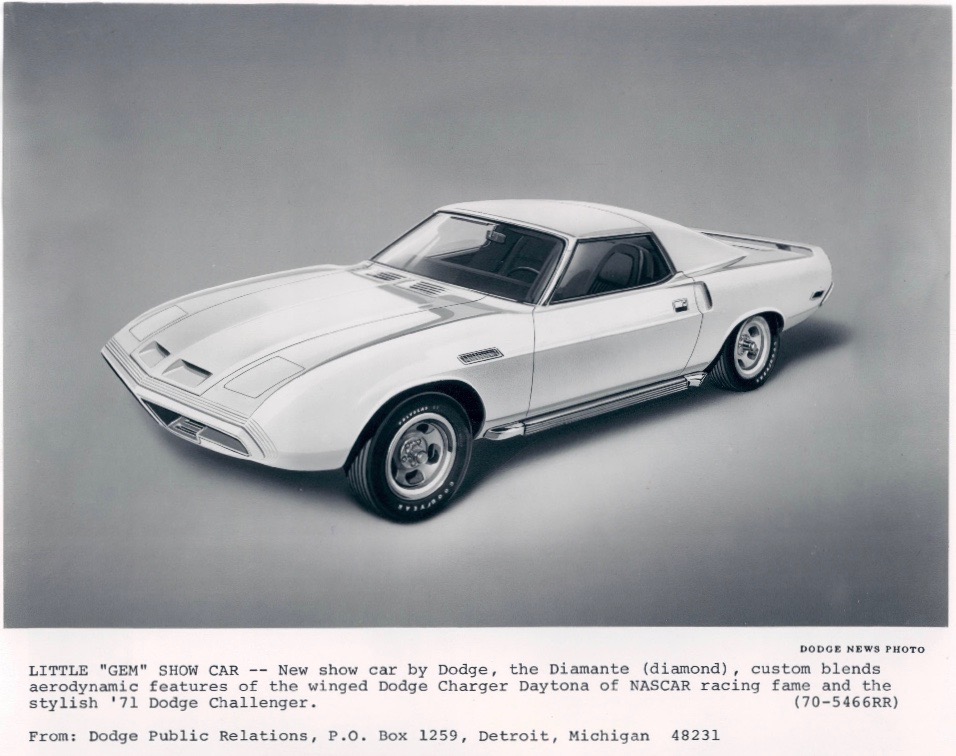
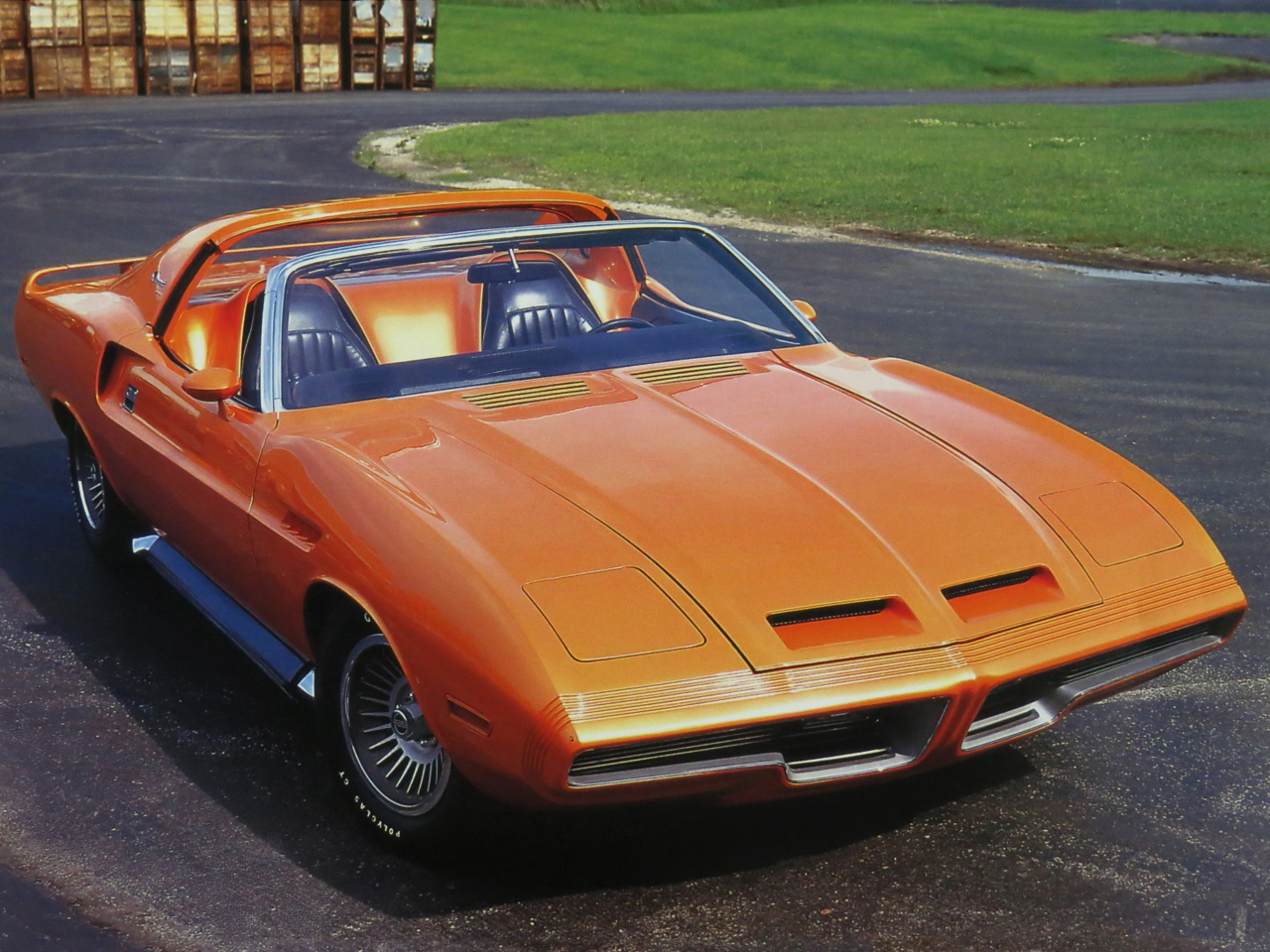
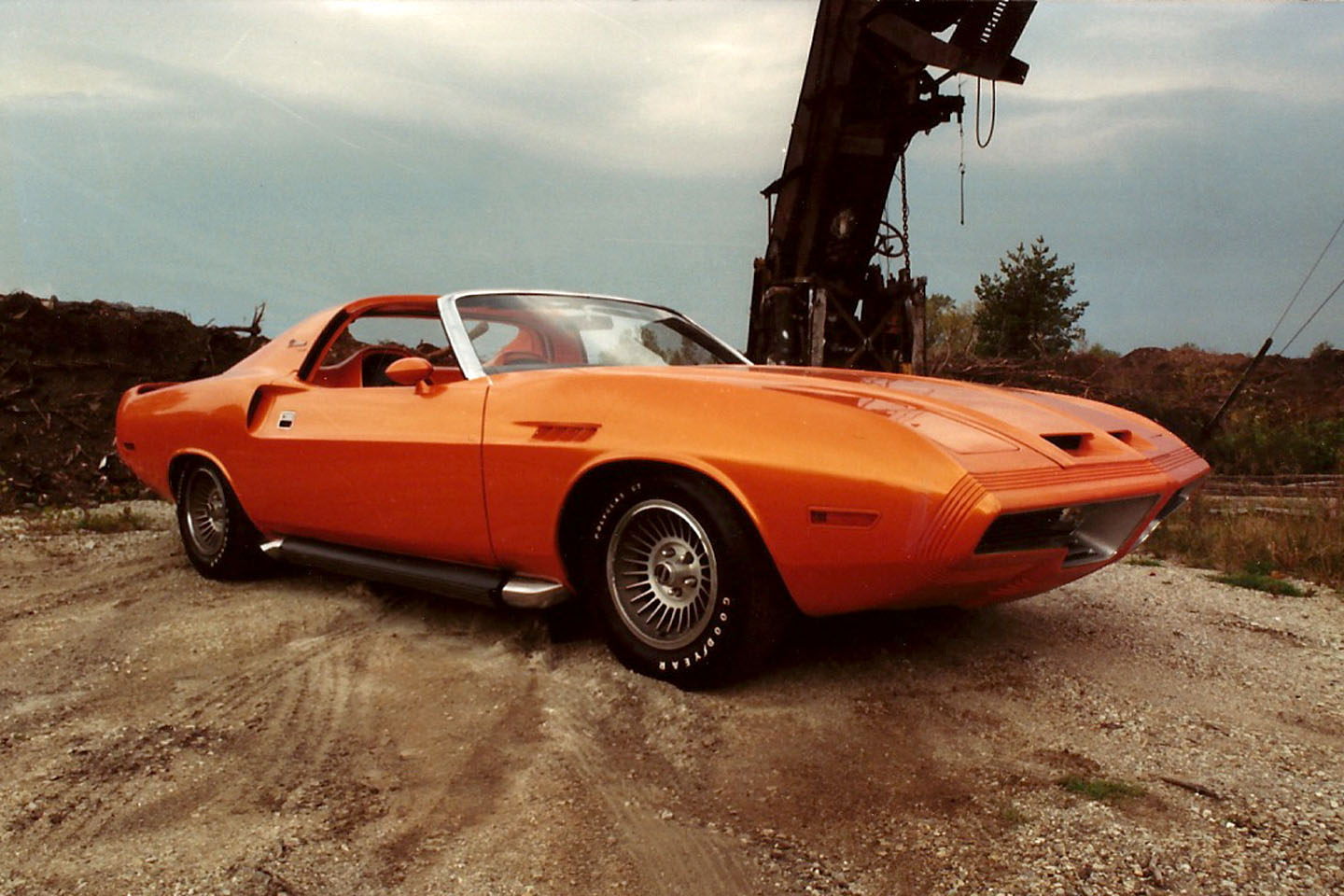
There’s a rather unusual aspect of the Dodge Diamante as late in its car show tour days the white paint got scratched up and the need came for a paint makeover. Chrysler sent the car to a shop (Creative Customs, Detroit, MI) but they never said anything about the actual color, most likely assumed a white car that needed a repaint would be again painted Pearl White. That didn’t happen!
Legend has it the painter George Busti disliked the white and took it upon himself to spray it a beautiful Candied Tangerine Orange hue. Word has it when the Diamante was returned to Chrysler, they were not exactly happy with the unauthorized change of hue! By this time, however, the car and the promotion of the E-body had run its course and Diamante went into storage. Years later, it was repainted back to Pearl White and today is reportedly in a private collection.
CULT CLASSIC
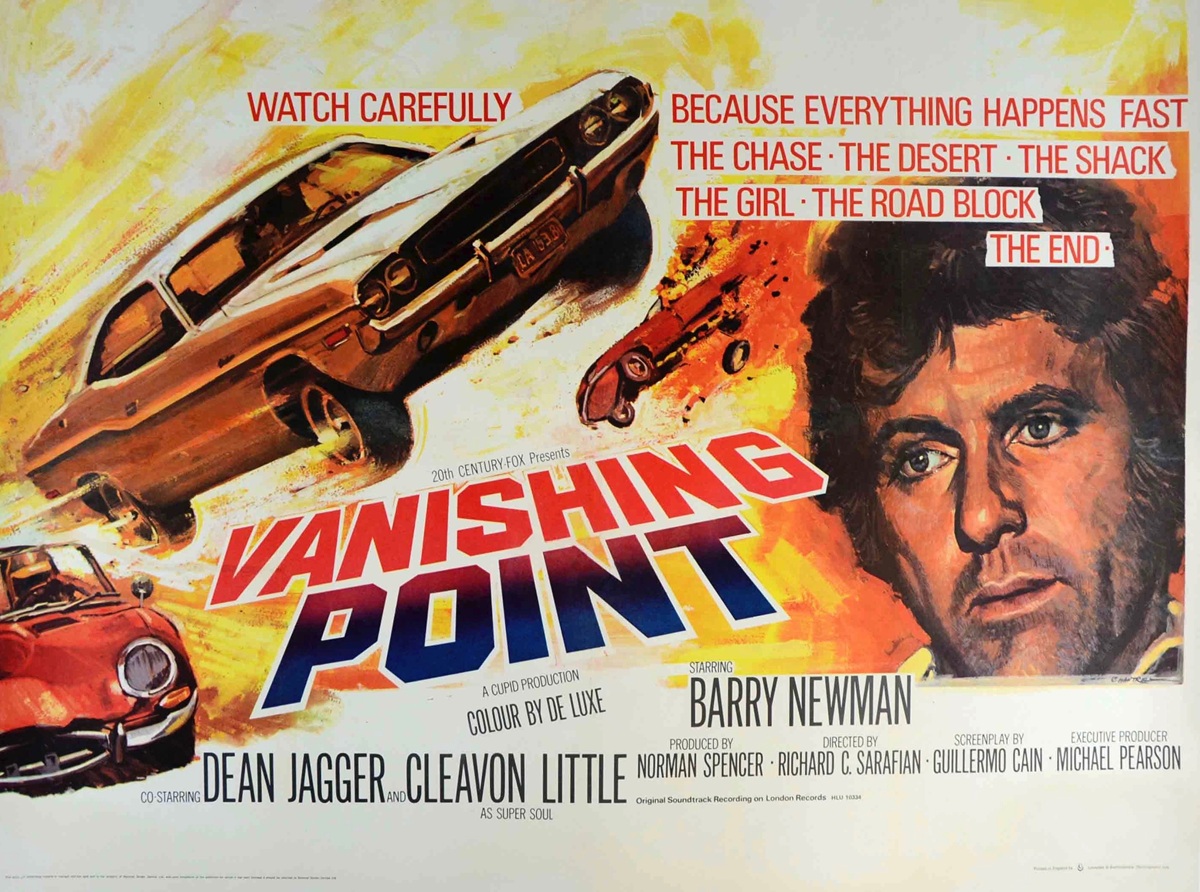
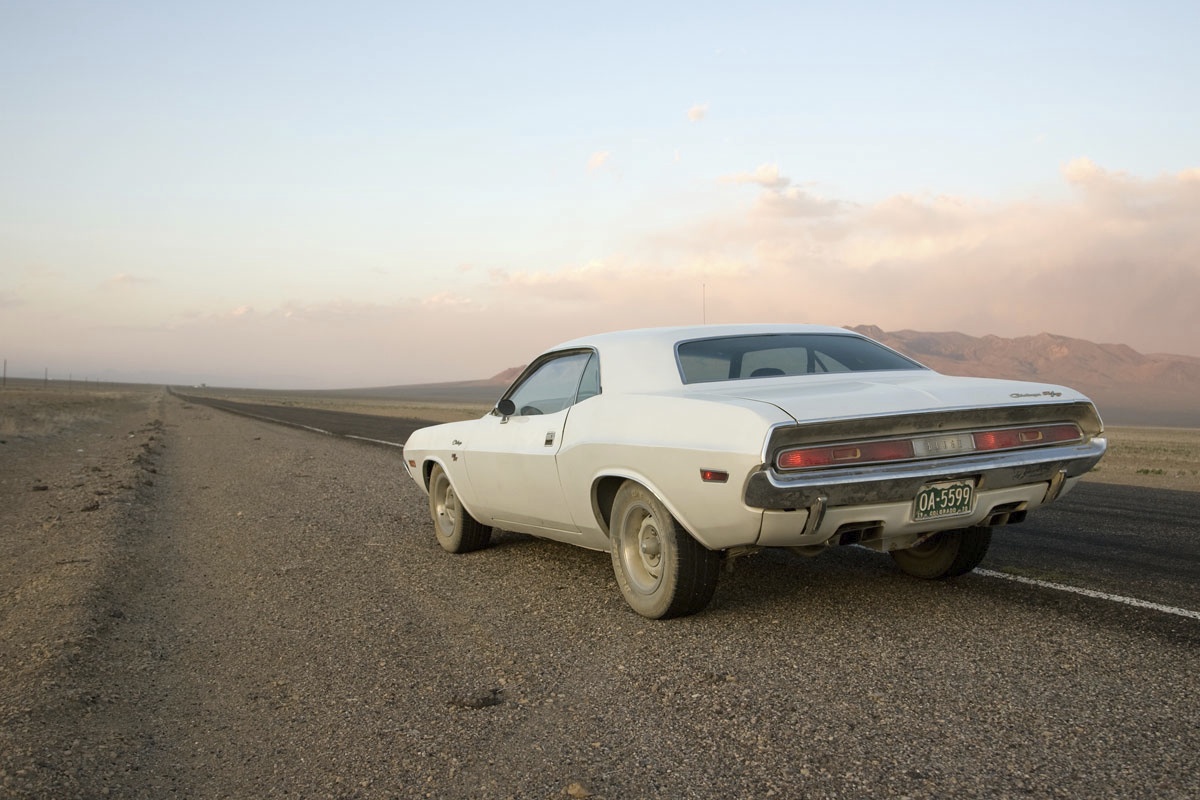
Legend has it total of five Alpine White 1970 Challenger R/Ts used, 1 with 383 Magnum (automatic), 4 with 440 Magnum (4-speeds), and loaned to Cupid Productions for the movie Vanishing Point by 20th Century Fox.The film ran 1 hour, 38 minutes and featured lots of car action, the rumble of the big wedge and the big deal was you make it from Colorado to California in under 15 hours… all with a good amount of recklessness from Kowalski (Barry Newman) and police pursuits. While it wasn’t released until March 13, 1971, the publicity for the Dodge Challenger (albeit a 1970) was overwhelming. All thanks to a Dodge Challenger, the car delivery driver, a former war hero, policeman and racing driver, experienced inner demons that ended up eating his soul!
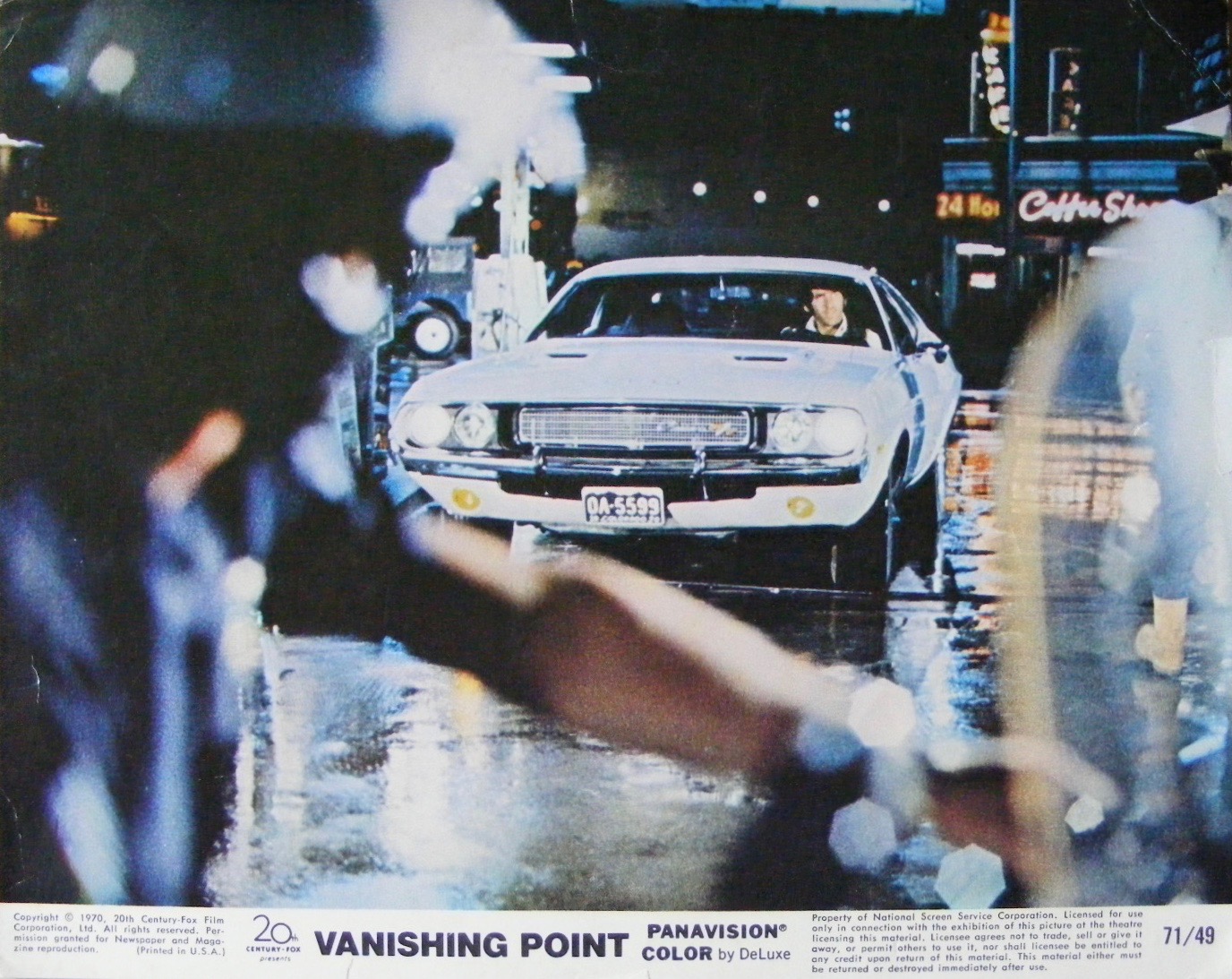
The Dodge Challenger was the star of the movie! No one could have ever dreamed Vanishing Point would achieve such a cult following not only among Mopar enthusiasts but for classic movie buffs in general.
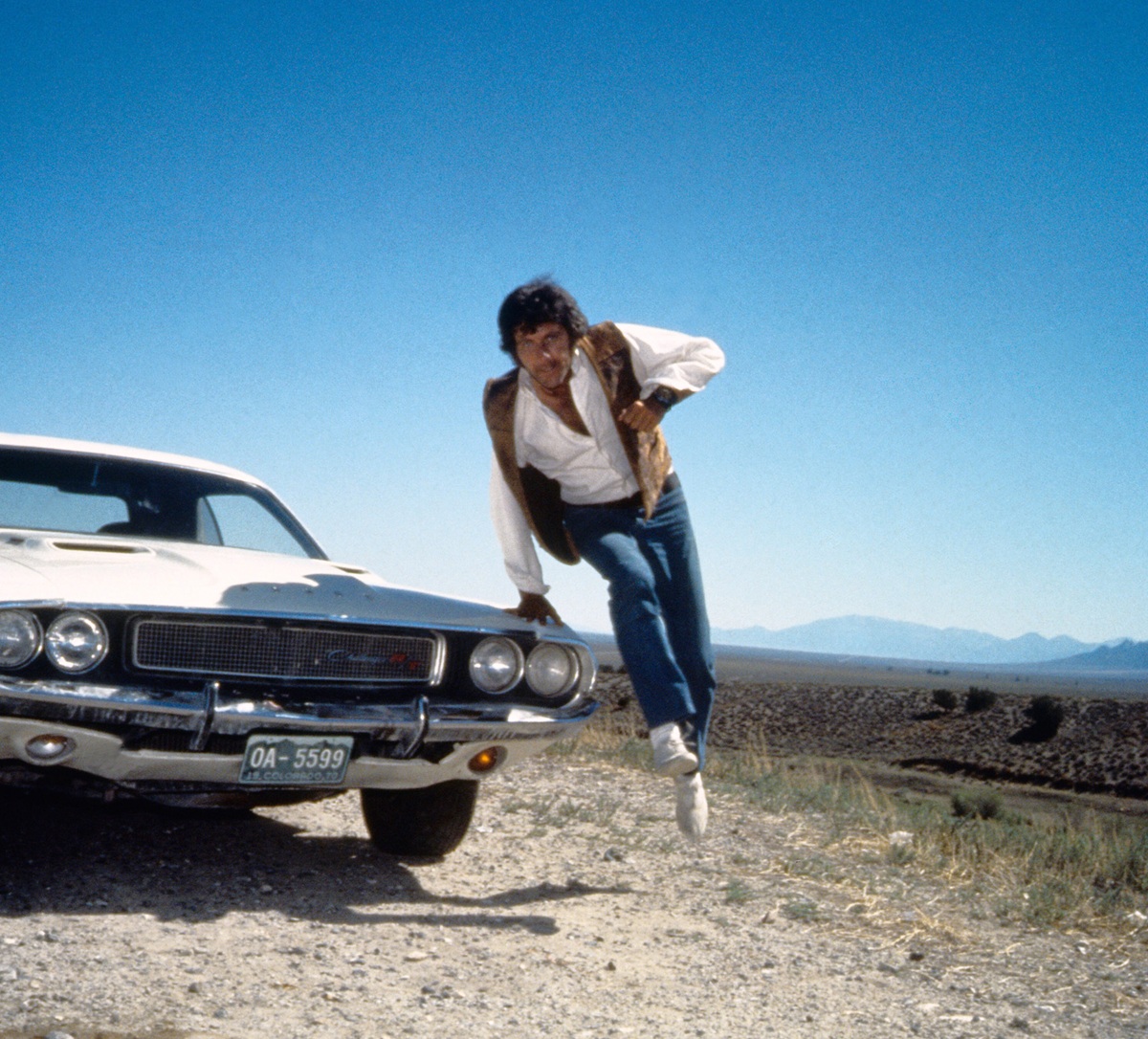
Kowalski (no first name was ever used in the movie) was played by 39-year-old Barry Newman, a somewhat unknown actor. He said this about the movie: “I had just done this film about a lawyer, a Harvard graduate, and I thought this is a different kind of thing. The guy was the rebel, the antihero, I enjoyed doing that very much.”
Carey Loftin, the original stunt coordinator of the movie, specified Dodge Challengers because of the “quality of the torsion bar suspension and for its horsepower. It was a real sturdy, good running car.”
Here’s what television viewers saw when the new Dodge Challenger came out:
VANISHING POINT MOVIE TRAILER:
_________________________
NEXT TIME:
DODGE GETS INTO SCCA TRANS-AM RACING WITH THE NEW 1970 T/A CHALLENGER!
Author: James Maxwell
0 Comments